Software Architecture Guidelines
The purpose of the Software Architecture Guidelines document is to provide a comprehensive and standardized framework for designing, implementing, and maintaining software architectures across all government institutions under the oversight of the Rwanda Information Society Authority.
- Introduction
- Software Architecture Principles
- Software Architecture Overview
- Government-specific Considerations
- Architectural Decision-making Process
- Architecture Documentation
- Technology Stack and Standards
- Collaboration and Governance
- References and Resources
- Appendix
Introduction
Purpose
The purpose of the Software Architecture Guidelines document is to provide a comprehensive and standardized framework for designing, implementing, and maintaining software architectures across all government institutions under the oversight of the Rwanda Information Society Authority. This document aims to ensure consistency, quality, and interoperability in software systems developed for government agencies. By establishing clear guidelines, this document aims to streamline software architecture decisions and enhance the overall efficiency, reliability, and security of government software solutions.
Scope
This document applies to all software development and architecture activities undertaken by or on behalf of government institutions under the oversight of the Rwanda Information Society Authority. It covers new software systems, major redesigns of existing systems, integration projects, and software procured from external vendors requiring customization. The guidelines encompass various deployment models including cloud-based and on-premises solutions, as well as different architectural patterns such as microservices, monolithic, and hybrid architectures.
These guidelines are mandatory for all government-funded software projects with budgets exceeding the threshold set by RISA, and are strongly recommended for smaller projects. Any exceptions require formal approval through the architectural review process outlined in Section 5 of this document.
Audience
This document is intended for various stakeholders within government agencies involved in the software development lifecycle. These include:
- Government IT Leaders: Responsible for overseeing software development initiatives, ensuring alignment with architectural standards, and promoting adherence to the guidelines.
- Software Architects: Responsible for designing the high-level structure and components of software systems in compliance with established architectural principles.
- Developers: Involved in implementing software systems based on the architectural designs and following the recommended technologies and practices.
- Project Managers: Responsible for project planning, execution, and ensuring that the architecture aligns with the guidelines.
- Quality Assurance and Compliance Teams: Responsible for verifying that software solutions meet the architectural and security standards set forth in the guidelines.
Roles and Responsibilities
The successful implementation of these guidelines requires coordinated effort across multiple roles within government agencies. Government IT Leaders ensure compliance with architectural standards and serve as the primary liaison with RISA, while Software Architects design systems according to these guidelines and document design decisions. The development process continues with Developers implementing approved designs following recommended technologies and security standards, supported by Project Managers who oversee alignment with architectural guidelines and coordinate reviews. Quality Assurance and Compliance Teams verify that solutions meet all standards through regular audits and assessments. Overall oversight is maintained by RISA, which provides guidance on standards interpretation, conducts periodic compliance reviews, and updates these guidelines as technology and best practices evolve.
Compliance and Monitoring
Adherence to these guidelines is monitored through a structured review process integrated into the project development lifecycle. All new projects subject to these guidelines must undergo architectural review at key milestones, including initial design approval, mid-project assessment, and final implementation verification. Project teams are required to submit architectural documentation and compliance evidence at each review stage, demonstrating alignment with the principles and standards outlined in this document. RISA conducts assessments of submitted documentation and may perform technical audits to verify compliance, identify implementation challenges, and gather insights for continuous improvement of the guidelines. Non-compliance issues are addressed through a graduated response process, beginning with technical guidance and support, escalating to formal remediation plans for persistent violations, and ultimately requiring project suspension for critical non-compliance that poses security or interoperability risks. The monitoring process also serves as a feedback mechanism to identify areas where guidelines may need clarification or updates to reflect evolving technology landscapes and emerging best practices.
Review and Update
These guidelines are reviewed and updated regularly to ensure they remain current and relevant in the rapidly evolving technology landscape. RISA conducts a comprehensive review of the guidelines annually, incorporating feedback from government agencies, lessons learned from project implementations, and emerging industry best practices. Ad-hoc reviews may be initiated when significant technological advancements, security threats, or regulatory changes necessitate immediate updates to the guidelines. The review process involves consultation with Software Architects, IT Leaders, and technical experts from various government agencies to ensure that updates reflect practical implementation experiences and address real-world challenges. Proposed changes are circulated for stakeholder input before finalization, and all updates are communicated to government agencies with appropriate transition periods for implementation. Version control is maintained for all revisions, with clear documentation of changes and their effective dates to ensure transparency and traceability throughout the guideline's lifecycle.
Overview
Software architecture plays a pivotal role in shaping the foundation and long-term viability of software systems. It defines the structure, components, interactions, and relationships that govern how software applications function and evolve over time.
Effective software architecture offers several benefits, including:
- Scalability: Well-designed architectures can accommodate growth and changing demands without significant rework.
- Modularity: Modular architectures enhance code reusability, maintainability, and ease of troubleshooting.
- Security: Thoughtfully designed architectures incorporate security measures to protect sensitive data and thwart potential threats.
- Interoperability: Sound architectural choices facilitate seamless integration with other systems and data sources.
- Performance: Architectures designed with performance in mind ensure optimal system responsiveness and resource utilization.
- Maintainability: Clear architecture documentation and adherence to best practices simplify maintenance and updates.
- Cost-effectiveness: Efficient architectures contribute to reducing development and operational costs.
- Risk Mitigation: Careful architectural decisions mitigate risks related to security breaches, system failures, and compliance issues.
By following these guidelines, government agencies can create software systems that not only meet immediate needs but also align with long-term objectives, promoting efficient governance, effective service delivery, and data security. The subsequent sections of this document delve into the principles, concepts, processes, and considerations necessary for achieving these goals.
Software Architecture Principles
Software architecture decisions for government agencies should be driven by a set of fundamental principles that ensure the development of robust, reliable, and sustainable software solutions. These principles form the foundation for creating architectures that align with organizational goals and industry best practices:
- Modularity: Decompose systems into modular components that are self-contained and have well-defined interfaces. This promotes reusability, ease of maintenance, and the ability to update specific components without affecting the entire system.
- Scalability: Design architectures that can scale both vertically and horizontally to accommodate increased workloads. Choose scalable patterns such as load balancing, caching, and partitioning to ensure optimal performance as demand grows.
- Security: Embed security practices at every level of the architecture. Implement mechanisms for data encryption, authentication, authorization, and auditing. Regularly assess and mitigate potential vulnerabilities and follow established security standards.
- Maintainability: Prioritize maintainability by following clean coding practices, adhering to design patterns, and creating clear documentation. This ensures that future modifications and updates can be implemented smoothly.
- Interoperability: Design architectures that can seamlessly interact with other systems and services, utilizing standard communication protocols and interfaces. This facilitates data exchange and integration with external systems.
- Performance: Consider performance requirements early in the design phase. Optimize critical paths, choose appropriate algorithms, and leverage caching and asynchronous processing to enhance system responsiveness.
- Reliability: Ensure the ability of a system to deliver its intended functionality consistently and predictably over time. It encompasses the system's ability to handle failures, errors, and disruptions while continuing to provide acceptable performance and service availability. A reliable software architecture minimizes downtime, data loss, and negative impacts on users, ensuring that the system remains dependable and resilient under various conditions.
These principles collectively guide architectural decisions, ensuring that the resulting systems are adaptable, secure, and well-suited for the unique needs of government agencies.
Software Architecture Overview
Key concepts and components of software architecture
Software architecture serves as the blueprint for structuring and organizing software systems. It encompasses several key concepts and components that define how the system functions as a whole:
Components: These are modular, self-contained units that encapsulate specific functionality. Components can be libraries, modules, or services that work together to fulfill the system's requirements.
Interfaces: Interfaces define how components interact with each other. Well-defined interfaces ensure proper communication and integration between components, promoting modularity and reusability.
Architectural Patterns: These are established templates for solving common architectural problems. Examples include the layered architecture, where different responsibilities are segregated into distinct layers, and the client-server architecture, where client and server components interact over a network.
Design Patterns: These are reusable solutions for common design challenges within a specific context. Examples include the Singleton pattern, which ensures only one instance of a class exists, and the Factory pattern, which centralizes object creation.
Examples of different architectural styles
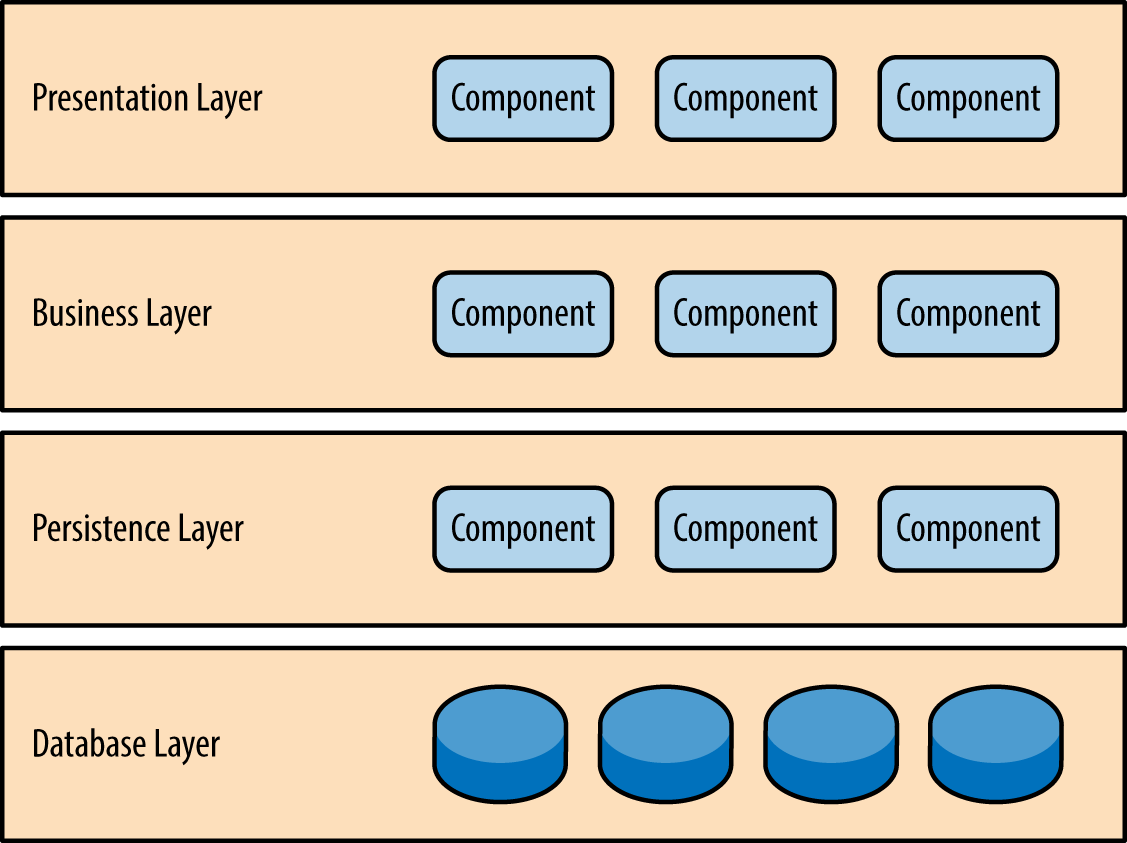
Layered Architecture: This style organizes components into distinct layers, each responsible for a specific aspect of functionality. It promotes separation of concerns and ease of maintenance. It's suitable for applications where clear separation of presentation, logic, and data layers is essential.
Graph: general example of layered architecture
Source: www.oreilly.com
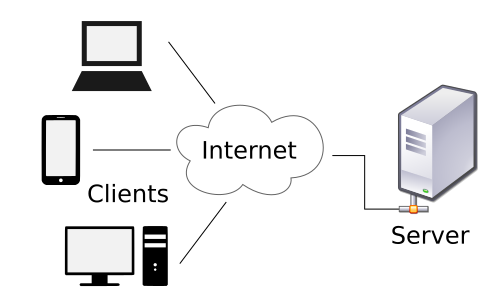
Client-Server Architecture: In this style, clients (user interfaces) communicate with servers (centralized processing units) over a network. It's ideal for applications that require centralized data management, security enforcement, and scalability.
Graph: general example of client-server architecture
Source: www.en.wikipedia.org
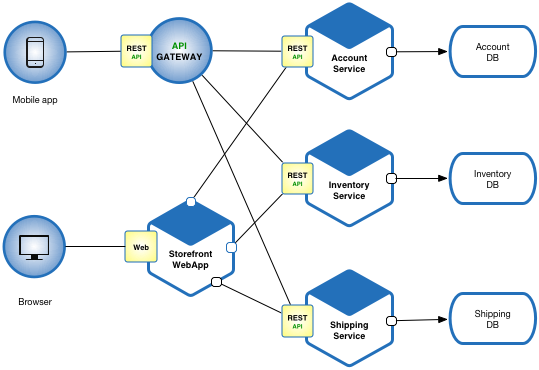
Microservices Architecture: Microservices break down applications into small, independently deployable services, each responsible for a specific business capability. This promotes agility, scalability, and ease of maintenance, making it suitable for complex systems with varying demands.
Graph: general example of microservices architecture
Source: www.microservices.io
Event-Driven Architecture: This style emphasizes communication between components through events and messages. It's suitable for systems with asynchronous and loosely coupled interactions, such as real-time updates, notifications, and complex workflows.
Graph: general example of event-driven architecture

Choosing the appropriate architectural style depends on factors like system complexity, scalability needs, inter-component interactions, and development team expertise.
Government-specific Considerations
Unique considerations specific to government agencies
When designing software architectures for government agencies, certain considerations are paramount due to the sensitive nature of governmental operations and the need for compliance:
- Regulatory Compliance: Government agencies often operate within strict regulatory frameworks. Architects must adhere to relevant laws, policies, and industry standards to ensure data security, transparency, and accountability.
- Data Privacy: Government systems handle citizens' sensitive information. Implement strong data protection mechanisms, including encryption, access controls, and proper user consent processes. In particular, ensure compliance to Rwanda's law on data protection and privacy.
- Security Standards: Government software must be highly secure. Implement multi-layered security approaches, including network firewalls, intrusion detection, secure coding practices, and regular security audits.
- Integration: Government systems often need to integrate with existing legacy systems to ensure continuity and efficiency. Plan for seamless data exchange by implementing well-defined APIs and protocols.
Specific requirements
- Procurement Processes: Architectures must accommodate government procurement procedures, such as vendor selection, contracting, and compliance with procurement regulations. Flexibility in architecture design should support procurement-related changes.
- Standards and Policies: Design architectures that align with government IT standards and policies. This includes using approved technologies, adhering to coding standards, and complying with information security policies.
- Open Data Initiatives: Consider open data principles, ensuring that architectures enable the sharing of government data with the public while respecting privacy and security.
Government-specific considerations demand meticulous planning and alignment with regulatory frameworks, ensuring that software solutions are secure, compliant, and effectively address the needs of citizens and agencies alike.
Architectural Decision-making Process
Recommended process for making architectural decisions
Effective architectural decision-making involves a systematic approach to ensure the best possible outcomes for government software systems
- Identify Stakeholders: Engage key stakeholders, including government officials, project managers, architects, developers, and end-users. Understand their requirements, concerns, and expectations.
- Requirements Analysis: Gather and document functional and non-functional requirements. Analyze the specific needs of the system, considering scalability, security, performance, and integration requirements.
- Explore Alternatives: Research and evaluate various architectural options that align with the identified requirements. Compare the pros and cons of each alternative, considering factors like cost, complexity, and long-term sustainability.
- Risk Assessment: Assess potential risks associated with each architectural choice. Consider security vulnerabilities, scalability challenges, and potential impacts on system performance.
- Decision Documentation: Document the selected architectural decision, including the rationale behind it, the stakeholders involved, the evaluated alternatives, and the risk assessment. This documentation serves as a reference point for future discussions and modifications.
Guidance on conducting architectural reviews and approvals
- Peer Reviews: Conduct regular peer reviews of architectural designs to gather input from other experienced architects. This helps identify potential blind spots and receive constructive feedback.
- Stakeholder Reviews: Share architectural decisions with stakeholders for their input and approval. Ensure alignment with their expectations and requirements.
- Architectural Review Boards: Establish a review board composed of senior architects and relevant stakeholders to ensure consistency and adherence to architectural guidelines. This board can review and approve critical architectural decisions.
- Documentation: Maintain a clear record of all architectural reviews, approvals, and changes. This documentation fosters transparency and accountability throughout the development lifecycle.
Adhering to a structured decision-making process and involving key stakeholders ensures that architectural choices are well-informed, aligned with government objectives, and capable of addressing complex challenges.
Architecture Documentation
Why document software architecture
Documentation is a crucial aspect of software architecture as it facilitates communication, understanding, and maintenance of complex systems:
- Communication: Documentation serves as a bridge between architects, developers, and stakeholders. It ensures that all parties share a common understanding of the architecture's structure, components, and interactions.
- Maintenance: Well-documented architectures are easier to maintain and update over time. Clear documentation helps new team members understand the system's design and reduces the risk of knowledge loss.
- Troubleshooting: Comprehensive documentation aids in identifying and resolving issues. It provides a roadmap for diagnosing problems, understanding dependencies, and making informed changes.
Guidelines for Effective Architectural Documentation:
- High-Level Overview: Begin with an executive summary that provides a high-level overview of the architecture's purpose, components, and benefits.
- Architecture Diagrams: Include visual representations of the architecture, such as high-level diagrams, component diagrams, and deployment diagrams. These diagrams illustrate the relationships between components and their interactions.
- Component Specifications: Describe each component's purpose, responsibilities, and interfaces. Include information about data flow, API endpoints, and any external dependencies.
- Interface Definitions: Clearly define the interfaces between components, including data formats, communication protocols, and expected behaviors.
- Deployment Models: Outline how the system will be deployed, including server configurations, network topology, and load balancing strategies.
- Design Decisions: Document the rationale behind key design decisions, including the reasons for selecting certain technologies, patterns, or approaches.
- Constraints and Assumptions: Identify any constraints, limitations, or assumptions that influenced the architecture's design.
Key artifacts that should be produced
- Architecture Diagrams: Visual representations of the architecture's structure, showing how components interact and how data flows through the system.
- Component Specifications: Detailed descriptions of each component's purpose, functionality, inputs, outputs, and relationships with other components.
- Interface Definitions: Clear definitions of the interfaces between components, including API specifications, communication protocols, and data formats.
- Deployment Models: Diagrams and descriptions of the deployment environment, including servers, databases, network connections, and load balancing.
Recommended standard modeling notations and tools for documenting architectures
Utilize well-established modeling notations and tools to ensure consistency and understanding across the development team.
Common modeling notations include:
- Unified Modeling Language (UML): A standardized visual language for modeling software systems. UML includes diagrams for various aspects of architecture, such as class diagrams, sequence diagrams, and deployment diagrams.
- Archimate: A modeling language specifically designed for enterprise architecture, including software architecture. It helps visualize relationships between different layers of an architecture.
- Draw.io: A versatile online diagramming tool that supports various diagram types, including flowcharts, UML diagrams, and network diagrams.
By using standardized notations and tools, architectural documentation becomes more accessible and comprehensible to all stakeholders involved in the software development process.
Technology Stack and Standards
Guidance for selecting appropriate tools for different architectural components
Selecting the right technologies and frameworks is crucial to achieving the desired functionality, performance, and maintainability in government software systems:
- Consider Requirements: Align technology choices with the system's functional and non-functional requirements, such as scalability, security, and performance.
- Evaluate Suitability: Assess how well a technology or framework fits the specific needs of each architectural component. Avoid overengineering or under engineering solutions.
- Leverage Expertise: Consider the skills and expertise of the development team. Choose technologies that team members are familiar with to ensure efficient implementation.
Mandated or recommended technology standards
- Programming Languages: While choosing programming languages consider factors like community support, performance, and integration capabilities as well as the team’s skills and expertise.
- Databases: choose database technologies based on the type of data being stored. Consider relational databases for structured data and NoSQL databases for unstructured or semi-structured data.
- Communication Protocols: Recommended communication protocols for integrating components within the architecture are REST APIs, GraphQL, and messaging queues based on their efficiency, community and ease of use.
- Security Frameworks: Ensure consistent implementation of security measures, such as authentication, authorization, and encryption.
Considerations for open-source software usage and licensing compliance
- Open-Source Software: Open-source software can provide cost-effective solutions, but ensure that selected projects are well-maintained, secure, compliant and aligned with your architecture's needs.
- Licensing Compliance: Review and comply with open-source software licenses to avoid legal complications. Keep track of licenses used and ensure proper attribution.
By following technology standards and selecting appropriate frameworks, government agencies can build software systems that are interoperable, secure, and capable of meeting long-term needs.
Collaboration and Governance
Collaboration and governance among government agencies
Collaboration and governance play a critical role in ensuring that software architecture decisions align with organizational objectives and standards:
- Consistency: Collaboration ensures that architectural decisions are consistent across government agencies, leading to interoperable systems and efficient data sharing.
- Alignment: Effective governance ensures that architectural choices are aligned with the established software architecture guidelines, fostering a coherent and well-structured IT landscape.
- Knowledge Sharing: Collaborative efforts facilitate the sharing of knowledge, experiences, and best practices among government agencies, promoting continuous improvement and innovation.
Recommendations
- Communities of Practice: Establish cross-agency communities of practice where architects and developers can share insights, challenges, and solutions. Regular meetings, workshops, and online forums can foster collaboration and knowledge exchange.
- Knowledge Sharing Platforms: Implement online platforms where government IT professionals can share architectural insights, best practices, and case studies. These platforms encourage learning and promote a culture of continuous improvement.
- Architectural Review Boards: Set up a review board composed of experienced architects and stakeholders from various agencies. This board can review major architectural decisions, ensuring consistency, compliance, and high-quality outcomes.
Promoting collaboration and governance across government agencies helps create a collective expertise that can drive the successful implementation of software architecture guidelines.
References and Resources
To ensure that government agencies have access to reliable sources of information and guidance, consider including the following references and resources:
- ISO/IEC 42010: International standard for describing the architecture of software-intensive systems. It provides terminology and concepts for describing architectural views and architectural frameworks. https://www.iso.org/standard/50508.html
- OWASP Top Ten: A list of the most critical security risks for web applications. It can help architects design systems with security in mind. https://owasp.org/www-project-top-ten/
- TOGAF: The Open Group Architecture Framework is a methodology and set of tools for enterprise architecture. While primarily aimed at enterprise architecture, it offers valuable insights for software architecture in government agencies. https://www.opengroup.org/togaf
- Rwanda data protection and privacy law: ensure that the architecture takes into consideration this law as a failure to do so, would simply make the application non-compliant. https://dpo.gov.rw/files/personal_data_protection_and_privacy_law.pdf
- Books and Publications:
- Documenting Software Architectures: Views and Beyond
- Architecture Patterns with Python: Enabling Test-Driven Development, Domain-Driven Design, and Event-Driven Microservices
- Clean Architecture: A Craftsman's Guide to Software Structure and Design (Robert C. Martin Series)
- Patterns of Enterprise Application Architecture
Appendix
Appendix 1. A checklist
Use this checklist to ensure that your agency effectively implements the software architecture guidelines.
Principles:
- Modularity: Are software components designed to be modular, with well-defined interfaces?
- Scalability: Have you considered scalability patterns to accommodate future growth?
- Security: Are security measures integrated throughout the architecture? Is data protection ensured?
- Maintainability: Are clean coding practices and design patterns applied for ease of maintenance?
- Interoperability: Is the architecture designed to interact seamlessly with other systems?
- Performance: Have performance requirements been addressed through optimization strategies?
- Reliability: Does the architecture account for fault tolerance and error recovery mechanisms?
Software Architecture Overview
- Components: Are software components clearly defined and well-documented?
- Interfaces: Have you defined interfaces between components to facilitate communication?
- Architectural Patterns: Is the chosen architectural style appropriate for the project's needs?
- Design Patterns: Are relevant design patterns considered for common challenges?
Government-specific Considerations
- Regulatory Compliance: Does the architecture adhere to relevant government regulations?
- Data Privacy: Are appropriate data protection mechanisms in place?
- Security Standards: Is the architecture aligned with government security standards?
- Integration: Have integration requirements with existing systems been addressed?
Documentation
- High-Level Overview: Does the documentation provide an executive summary of the architecture's purpose and benefits?
- Diagrams: Are architecture diagrams, including high-level and component diagrams, included?
- Specifications: Are detailed specifications of each component provided?
- Interfaces: Are interfaces between components clearly defined?
- Deployment Models: Are deployment diagrams and descriptions included?
- Design Decisions: Are key design decisions documented with their rationale?
- Constraints and Assumptions: Are any constraints or assumptions made during design documented?
Using this checklist, your agency can systematically assess its adherence to the software architecture guidelines and ensure a successful implementation process that aligns with the best practices outlined in the document.