Vision and Objectives
Smart Rwanda Master Plan Context
In October 2015, The Government of Rwanda issued the “SMART Rwanda Master Plan” (SRMP), which provides the elements needed to achieve the vision of “a Knowledge Based Society”. SRMP identified a set of core objectives, including the following:
-
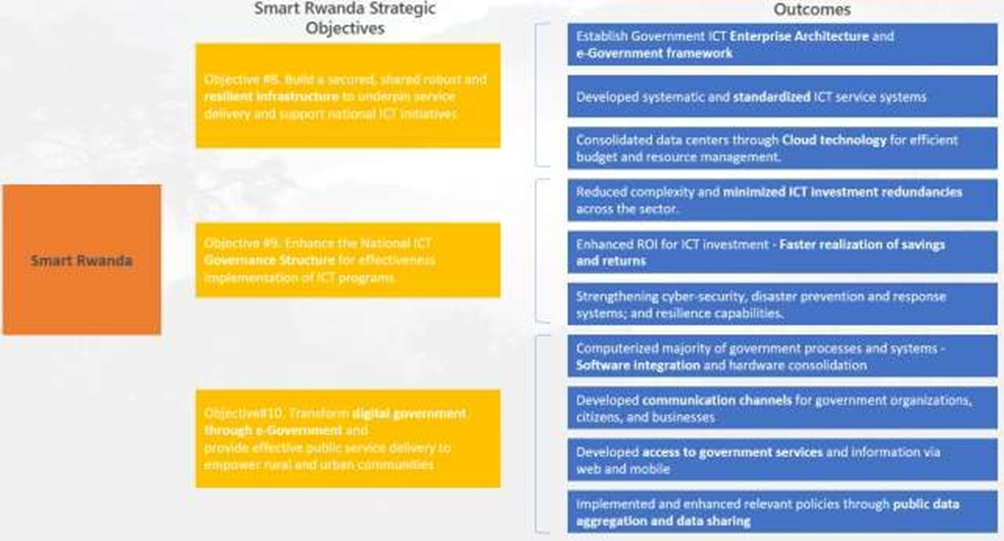
- Objective #8: Build a secured, shared robust and resilient infrastructure to underpin service delivery and support national ICT initiatives
- Objective #9: Enhance the National ICT Governance Structure for effectiveness
- implementation of ICT programs
- Objective #10: Transform digital Government through E-Government and effective service delivery
SRMP also identified three main enablers for Rwanda’s digital transformation: Effective ICT Governance and Management, ICT Capacity and Capability, and Secured and Shared Infrastructure.
The following diagram summarizes the expected outcomes from the SRMP in relation the with objectives listed above:
The objectives and outcomes above are to be executed under the SMRP identified policy principles:
- Access:
- Cloud First
- Mobile by Default
- Infrastructure Sharing
- Bring Your Own Device
- ICT Affordability
- Security by design
- Service Data and Innovation
- Open by Default
- Efficient Business Processes
- Privacy Data Protection
- Innovation and PPP
- ICT Skills and Capacity Building
- Governance
SRMP recognizes the fact that building digital government services requires the establishment of a government ICT enterprise architecture and e-government framework that provides shared services needed for service delivery. However, this set of shared services, while critical for digital service delivery, has not yet been fully identified or documented. The objective of this document, and the corresponding Rwanda Digital Government Platform, is to define the framework for these services.
The One-Stop-Shop Vision
The Government of Rwanda is actively engaged in a program of evolution into a smart, Digital Government. The objective is to deliver and manage services electronically and efficiently—both internally and to businesses and citizens.
Better, broader, and more efficient access to the wide diversity of public services is a key driver for these changes. Equally key is the development of more efficient and streamlined internal business processes. Rwanda would like to capitalize on the development of digital channels such as mobile services and interactive citizen services – to encourage citizens to participate more actively with government. Businesses too can see the benefits: reducing the complexity and bureaucracy of their interactions with the government through the smart application of technology.
The vision is best summarized through the concept of a one-stop-shop, where all government services are presented in an integrated, seamless way that simplifies access to citizens and businesses.
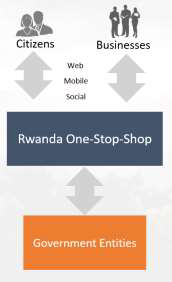
To enable the One-Stop-Shop concept, a set of critical information technology services need to be made available to the entire ecosystem. We refer to these services as the Digital Government Platform. On top of this platform, and within the One-Stop-Shop concept, vertical solutions can be built up, including enabling digital health, law, and others.
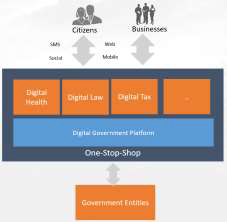
IMPORTANT: The Digital Government Platform depends on having automation within the government entities. It does not provide the automation of government entity processes but helps in integrating existing automated processes and using them to provide digital services to citizens.
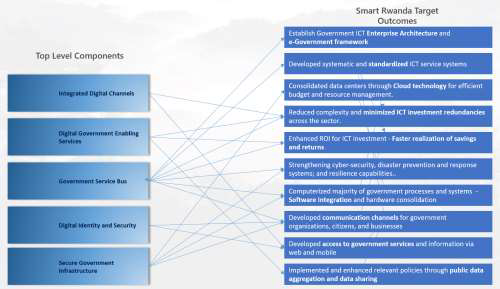
The Digital Government Platform will enable the adherence to the policy principles highlighted in the SMRP as well as the facilitation of the objective outcomes.
The following diagram shows the mapping between the Digital Government Platform's top-level components and the relevant SMRP outcomes:
Expected Benefits of the Digital Government Platform
Providing a common infrastructure shared by multiple digital government services can produce benefits in several categories:
Constituency (Citizen, Organization, Intermediary)
The benefits for the "clients" of digital government services include:
- Reductions in cost and time to enable online transactions in a consistent, reliable fashion
- Hidden complexity and multiplicity of back-end systems interactions at the point of delivery, presented as a single online interaction
- Simplified processes for interacting with government across silos, including the potential for “joined-up” services
- Faster access to services
- Single online identity to access multiple government services across multiple channels
- An always-available 24x7 service.
Government
For the Government of Rwanda, the common Digital Government Platform:
- Accelerates the delivery of e-Government services by providing reusable common components needed for online service delivery
- Shares common costs across the Government rather than repeating expenditure multiple times by duplication of identical pieces of core infrastructure for each online service
- Enables innovative, joined-up services
- Provides a common user identity management model for all Government services
- Provides a single, consistent access path for Government services
- Scales to meet the growing demand
- Drives the take-up of Digital Government services
Application Developers and Independent Software Vendors
For application developers and software vendors building Digital Government solutions, the
Digital Government Platform:
- Provides consistent interoperability—consistent standard interfaces expose the functionality, regardless of the services and departments concerned so applications can be built in a consistent way
- is platform and technology independent
- Complies with open standards