ICT Spend Control Guidelines for Public institutions
To ensure coordinated planning for ICT needs/Projects across public institutions, all Budget Agencies at Central and Local Gov’t level have to fill and submit the ICT Needs planning Template with details of any ICT related activities or projects including development of ICT infrastructure, acquisition of ICT hardware equipment, software solutions and applications. This allows MINICT and RISA to review the submissions in view of the National ICT Development Agenda and for alignment with projects being implemented centrally, as well as advising institutions accordingly.
- Introduction, Purpose, and Scope
- ICT Spend Control Process
- Elements to consider when Developing ICT solutions
- ICT Needs Planning Process
- Engagement with RISA and other stakeholders
- Access to Spend Control guidelines and ICT Needs Planning Template (links to website/portal)
- How to submit ICT plans
- Documents you need to have when submitting your ICT needs planning template
- ICT Spend Control Governance
- ICT Spend Control Calendar
- Implementation of ICT Spend Control
- Enforcement of spend control guidelines
Introduction, Purpose, and Scope
Introduction
To ensure coordinated planning for ICT needs/Projects across public institutions, all Budget Agencies at Central and Local Gov’t level have to fill and submit the ICT Needs planning Template with details of any ICT related activities or projects including development of ICT infrastructure, acquisition of ICT hardware equipment, software solutions and applications. This allows MINICT and RISA to review the submissions in view of the National ICT Development Agenda and for alignment with projects being implemented centrally, as well as advising institutions accordingly.
Purpose
The purpose of these guidelines is to provide a framework that governs the coordination for ICT needs planning /Spend control across public institutions.
These guidelines will help you set out what you will need to include to support your submission and will help you provide the right details and supporting documents so that you can get your project approved. It helps ensure:
- user needs are front and center of all our work
- that we achieve best value for money, with clear outcomes and outputs
- that programmers and projects meet the wider digital and technology strategies
Adoption of these guidelines will also allow public institutions to:
- Improve the ICT Needs planning process (Stopping guess work planning)
- Guide Government Budget Agencies on how to spend money on ICT Projects
- Prioritize key ICT Projects and know where to spend
- Avoid duplication of ICT Projects across sectors
Scope
These guidelines are expected to be followed by all public institutions including institutions at central and local government as well as all their affiliated agencies and parastatals (Districts and District Hospitals) regardless of the source of budget either Government of Rwanda (GoR) budget or development partners budget.
They will cover all ICT solutions such as network infrastructure, end-user equipment, software applications, IT security devices and will be directed by institutional and National ICT strategies and policies.
ICT Spend Control Process
RISA has developed the new spend control process to improve ICT Needs Planning and be able to measure ICT investment and benefits on ICT Solutions that are acquired in every Financial Year. The new spend control process has been mapped and can be accessed here: ICT needs Spend control process and Calendar
Elements to consider when Developing ICT solutions
- Institutions and sectors should first identify gaps that need to be solved with the help of ICT solutions based on the latest technologies available.
- Develop collaboration and Partnership with National and international centers of excellence that do research in the ICT domain.
- Identify innovative solutions based on best practices and success stories by benchmarking on the global market.
- Institutions are encouraged to produce home based ICT solutions
- Systems/ Software with high confidentiality and sensitive data to be developed by QT Software Limited and Software/Systems with Low confidentiality and non-sensitive data to be developed by Sector in-house team (Senior Developers and Developers).
ICT Needs Planning Process
- At the beginning of August of every Financial Year, institutional Planners in collaboration with digitalization office leaders will share the updated ICT Planning template and Spend Control guidance to the user departments to collect ICT wish list solutions, analyze them and come up with tangible projects that can be considered in their plans.
- Schedule institutional Spend Control committee meeting chaired by CDO/Business Analyst/DG/Sector Strategic Planning Specialist to agree on the projects that fulfill requirements based on the institutional Priorities and Innovative solutions that can be applied within the institutions.
- Schedule Sector Spend Control committee meeting to analyze priority projects across the sector and pre-approve projects that should be submitted to RISA and MINECOFIN to seek final approval.
- RISA shall organize consultation workshops with sectors to assess ICT Needs based on Sector Strategic Priorities, National ICT strategies and High Level decisions (Presidential pledges, Resolutions from National retreat and dialogues).
- ICT Projects that are supported by Development Partners (DPs) should have required project documents (Technical requirements, Business Requirement Specifications, System Requirements Specifications, Terms of Reference, Concept Note or Feasibility Study reports) approved by Sector Digitalization Leaders (CDOs/Business Analysts/Senior Developers or DGs).
- Sector digitalization leaders shall schedule meetings with Development Partners that support sector ICT projects to ensure alignment with planning requirements and guidelines.
Engagement with RISA and other stakeholders
During the ICT Needs planning process, institutions are advised to involve RISA Spend control team, other Institutions within the same sector and Development Partners at an early stage to avoid any duplication of ICT initiatives to ensure proper planning alignment within the sector. Also, institutions should collaborate with RISA during the assurance and benefits/impact realization stage.
Access to Spend Control guidelines and ICT Needs Planning Template (links to website/portal)
Spend Control guidelines and ICT Planning template can be accessible through different platforms as follows:
- RISA Website
- Ministry of Finance and Economic Planning website as an Annex in the First Planning and Budgeting Call Circular (PBCC1).
How to submit ICT plans
The properly filled in ICT Planning templates will be submitted to RISA through this link.
To collect early stage inputs from RISA Spend Control team and after incorporating feedback, the final planning template will be submitted to government enterprise repository portal.
Documents you need to have when submitting your ICT needs planning template
Depending on the nature of the ICT Project, the institution is required to submit the supporting documents along with the completed planning templates. Therefore, RISA would expect to see the following documents as listed below:
If New projects valued below one million USD are qualified as “Small projects” one of the following documents is needed.
Concept Note
Key components:
- Situation assessment and identification of possible alternative solutions
- Logical framework outlining the Project’s result chain through presentation of overall objective (impact), specific objectives (outcome(s)), outputs, and activity matrix with details on means (resource inputs) and costs.
- Justification of the selected technical option,
- Conceptual solution for the selected option,
- Detailed budget estimates for the project,
- Basic implementation plan, milestones,
- Identification of Funding and Cost Recovery Options,
- Project’s Socio-Economic Impact,
- Justification in relation to the National Planning Framework
- Conceptual Study
Terms of reference
Key components:
- project background,
- project objectives,
- Issues to be explored and analyzed against certain criteria,
- implementation methodology,
- Expertise required,
- reporting requirements,
- work plan including activity schedule.
Technical Assessment report
(i.e. Institutional network renovation, Installation of new ICT infrastructure like 4GLTE, fiber optic deployment, etc.)
Key components:
- executive summary,
- scope and content,
- general findings,
- general recommendations,
- proposed solutions,
- estimate budget,
- conclusion.
If New projects valued above one million USD but below 15 million USD in investment is considered as “Medium projects” the following documents are needed
Feasibility study
Key components:
- description of the context,
- definition of objectives and logic of the intervention,
- identification of the project,
- demand and option analysis,
- environmental and social considerations, including Environmental and Social Impact Assessments,
- technical design and cost estimates,
- plan for implementation and - if applicable - operation of the project,
- financial, economic and sensitivity analysis,
- risk analysis,
- conclusions and recommendations.)
The validated feasibility study should be submitted along with ICT Needs planning template.
All supporting documents should be approved by the Chief Budget Managers of the institutions that are submitting projects
ICT Spend Control Governance
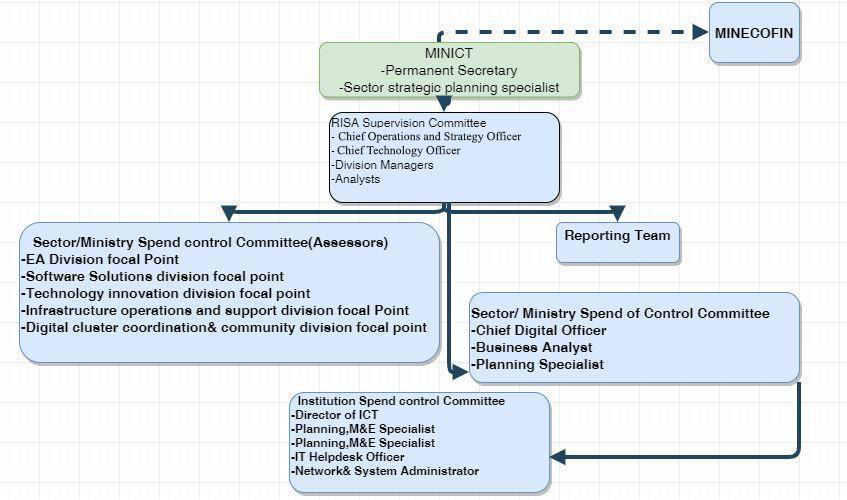
To improve ICT Needs planning, monitor the implementation of the funded ICT Projects as well as measuring benefits/impact, spend control teams have been established at different levels as follows:
Ministry Level:
CDO/Business Analyst, Sector strategic planning specialist, Statistician, Sector Strategic Monitoring and Evaluation Specialist.
Institutional level:
Director of ICT/DG/CIO, Planning M&E Officer, ICT Help Desk Officer, Statistician (where applicable)
District Level:
Network and System Administrator, Director of Planning, Planning, M&E officer, Statistician.
MINICT
Public Sector Digitization Analyst, Future planning Directorate General (Sector strategic planning specialist, Sector M&E Specialist, Statistician)
RISA
COSO and CTO, Division Managers, Analysts, Principal DevOps Engineer, Sector focal Person from Divisions, Sector technical working group members.
Roles and Responsibilities of ICT Spend control members
|
S/N |
Institution |
Position |
Roles and responsibilities |
|
1. |
MINICT |
Public Sector Digitization Analyst |
Provide guidance and digitalization journey in collaboration with sectors CDO’s office. Support the implementation of e-Government projects. |
|
2. |
Sector strategic planning specialist |
Ensure that sectors ICT plans are aligned with
|
|
|
3. |
Sector M&E Specialist |
Collect, consolidate and analyze periodic performance reports and propose recommendations for improved spend control Service delivery |
|
|
4. |
Statistician |
|
|
|
|
|
|
|
5. |
RISA |
COSO and CTO |
|
|
6. |
Division Managers |
|
|
|
7. |
Analysts/Principals |
|
|
|
8. |
Sector focal point from Divisions |
|
|
|
9. |
Line Ministry level |
CDO/Business Analyst |
|
|
10 |
Sector strategic planning specialist |
|
|
|
|
|
strategic plan, medium term plan, and annual action plan; |
|
11 |
Sector Strategic Monitoring and Evaluation Specialist |
Collect, consolidate and analyze periodic performance reports and propose recommendations for improved spend control Service delivery |
|
|
12 |
Affiliated institutions/ Agencies |
IT Help Desk Officer |
|
|
13 |
Director of ICT or DG or CIO |
Coordinate and Present the spend control activities across the sector. |
|
|
14 |
Planning M&E Officer |
Work closely with CDO’s office in institutional ICT needs and projects planning. |
|
|
15 |
District |
Director of Planning |
Develops the Institution’s plan in collaboration with other departments
|
|
16 |
Network and System Administrator |
Advise on the ICT Projects the district needs to acquire |
|
|
17 |
Planning officer/M&E officer |
Work closely with CDO’s office in institutional ICT needs and projects planning. |
General ICT Spend Control Governance Structure
ICT Spend Control Calendar
Due to the fact that the current ICT needs planning period is not enough, it has been found important to develop an ICT Spend control calendar that can allow early planning and be able to comply with MINECOFIN calendar. This calendar sets out key dates from August to December showing when to start planning, consultations workshops and submission of plans.
To access ICT Spend Control Calendar, please click on the link.
Implementation of ICT Spend Control
Each institution should establish an implementation plan customized to its affiliated institutions natures and mandates ensuring effective implementation of the new spend control guidelines based on the user research findings, sector pain points, national ICT plans and submit it to RISA with a copy to MINICT and MINECOFIN for monitoring and coordination purposes.
- The established plan should focus on all the key aspects highlighted in these guidelines and should indicate clear expected timeframe for each planned ICT Project or activity.
- The internal sector implementation plan should also include citizen/customer participation showing key pain points to be addressed and rights of service’s recipients.
- Internally, each public entity should ensure clear understanding and implementation of spend control guidelines as well as the monitoring progress of the implementation plan.
RISA jointly with MINICT and MINECOFIN in collaboration with CDO's offices will regularly monitor the implementation status of ICT projects to allow accomplishment of the intended results towards increased innovative, transformative and citizen centric solutions.
Enforcement of spend control guidelines
Chief digitalization offices in collaboration with RISA are required to adopt and enforce implementation of these spend control guidelines in all institutions under their mandate.
Ministry or institutions/Agencies which do not follow these guidelines their submissions will not be approved and this will affect the allocation of funds to your ICT Needs/ Projects.