Network and Communication Infrastructure
This section provides guidelines and requirement for deployment of IT networks across institutions in three categories:
Network Design
- Number of users in the institution: identify the number of network users both onsite and offsite.
- Services accessed or offered by the institution: services should be defined and
categorized depending on processes and availability requirements - Broadband technology: should be chosen according to location, institutional business requirements, and offices set up. Wireless local area networks are advised for convenient and modernized work spaces
- Bandwidth requirement1: minimum bandwidth requirement should be according to
user needs.
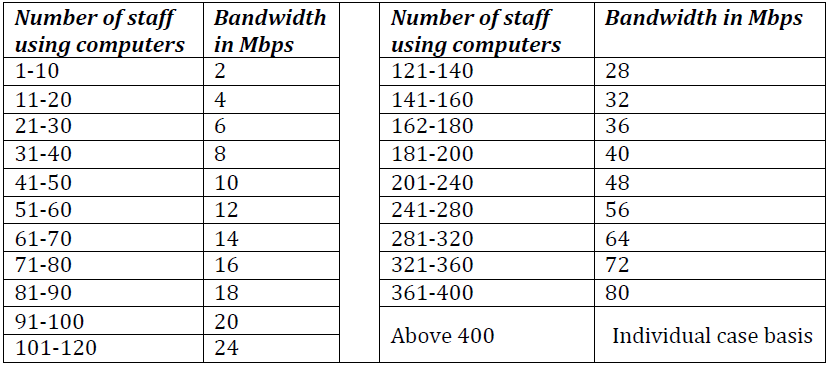
- Physical network diagram: should consider the number of users based on the organizational structure, interior design of the building and sitting arrangement (i.e. whether all users sit on same Floor or on different Floors)
- Logical network diagram: should take into account systems, service, and applications according to the institutional business processes.
The physical and logical network infrastructure design in Government institutions should be put in four categories based on the number of users:
− Category 1: Small-sized network infrastructure for up 30 users
− Category 2: Medium-sized network infrastructure for up 50 users
− Category 3: Large-size network infrastructure for about 100 users
− Category 4: Network infrastructure for more than 100 users
- Network security: all government institutions should comply with the cybersecurity directives adopted in June 2018 for network and information systems.
Network Implementation
- Network equipment: network equipment and devices comprising the core network infrastructure to provide connectivity and security features include rack, minimum routers, switches, and access points, as well as a firewall.
- Network cabling, labeling and physical layout: any network structure should consider latest cabling and labeling standards.
- Communication room: institutions should have communication rooms at their premises when proven necessary and should comply with the following minimum requirements:
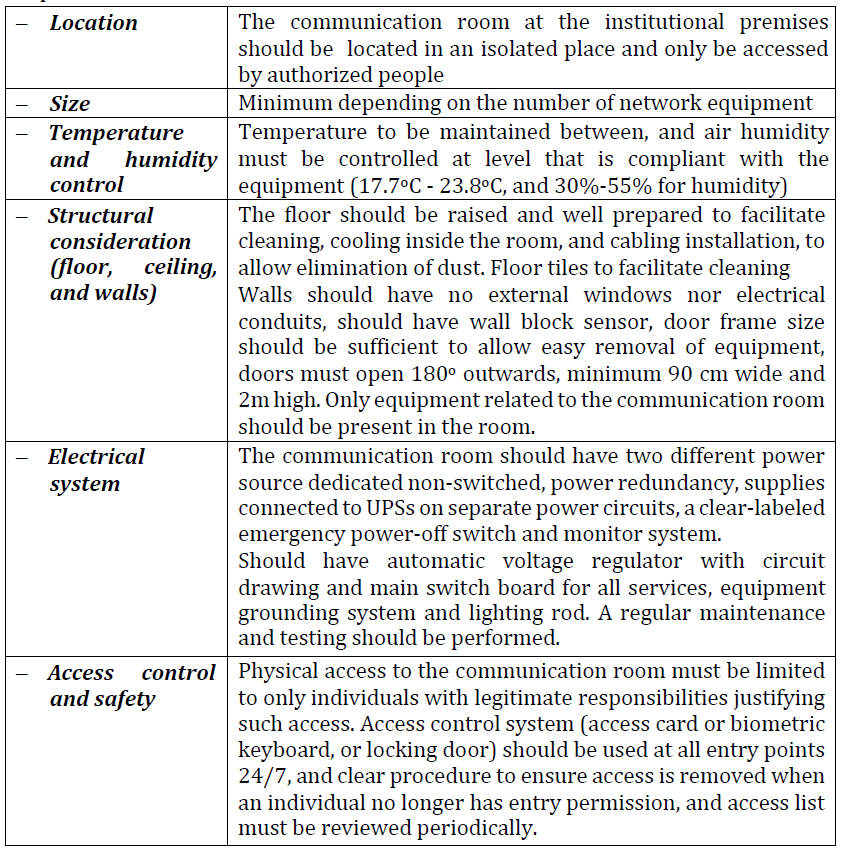
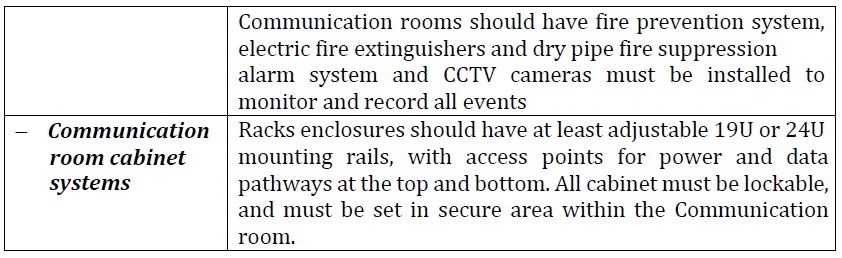
In addition to the above minimum requirements, the following are guidelines for network equipment in the communication room:
− Switches: small medium and large institutions are advised to use 24 ports, PoE,
10/100/1000, 4 T/Small Form-Factor Pluggable (SFP) LAN Base image. A 48 ports switch may be used for larger institutions.
− UTP data patch panels: should be of CAT6, 24 ports or more depending on latest technology.
− Routers: should support high-bandwidth module-to-module communication at
higher speeds based on the platform, some of the 10/100/1000 Ethernet ports can support small-form factor pluggable (SFP) based on connectivity in addition to RJ-45 connections, enabling fiber or copper connectivity.
− Firewall: latest firewall network security should be implemented. (For more details on requirements refer to Cyber Security directives)
Access Points: the number of access points may vary depending to the building configuration, advisable wireless standards are 802.11a/b/g/n/ac (2.4 GHz/5
GHz)
− LAN Ethernet cabling: CAT6 FTP or advanced types.
- Documentation: this includes network drawings, network connection and configuration information, addresses of all devices on the network with static IP addresses, and log documents. The document versions should be reviewed periodically, and any changes should be tracked.
Network Management
- Network performance: redundancy, load balancing, application response time, and quality of service should be controlled and assured.
- Network maintenance: each institution should elaborate a network maintenance
plan, together with the disaster recovery and business continuity plan.