# Enterprise Architecture Domains

As stated<span style="letter-spacing: -.15pt;"> </span>above,<span style="letter-spacing: -.1pt;"> </span>enterprise<span style="letter-spacing: -.1pt;"> </span>architecture<span style="letter-spacing: -.1pt;"> </span>seeks<span style="letter-spacing: -.1pt;"> </span>to<span style="letter-spacing: -.05pt;"> </span>address business requirements<span style="letter-spacing: -.25pt;"> </span>that<span style="letter-spacing: -.1pt;"> </span>would<span style="letter-spacing: -.15pt;"> </span>bring added value to the organization and its target customers.<span style="letter-spacing: 2.0pt;"> </span>To achieve this, leading practice has identified five interlinked domains that make up enterprise architecture. These are Business, Information, Data, Application, and Technology Architecture domains.

The modified Government of Rwanda Enterprise Architecture Framework has combined some of the closely aligned domains so that the view is made up of the following three core domains:

1. <span style="mso-list: Ignore;"><span style="font: 7.0pt 'Times New Roman';"> </span></span>**Business Architecture** – This is the apex architecture domain as it sets the requirements for the other supporting one. Within the Business Architecture domain, the organization’s strategic mandate is defined and this sets the foundation for business requirements that the other architecture domains seek to address.<span style="letter-spacing: 2.0pt;"> </span>Within the business architecture domain, therefore, the following<span style="letter-spacing: -.6pt;"> </span>elements<span style="letter-spacing: -.55pt;"> </span>are<span style="letter-spacing: -.5pt;"> </span>defined:<span style="letter-spacing: -.5pt;"> </span>Business<span style="letter-spacing: -.65pt;"> </span>strategy,<span style="letter-spacing: -.6pt;"> </span>governance,<span style="letter-spacing: -.65pt;"> </span>organisational<span style="letter-spacing: -.5pt;"> </span>structure,<span style="letter-spacing: -.55pt;"> </span>Business Rules, key business processes, business locations and services.<span style="letter-spacing: 2.0pt;"> </span>These set the direction for the organisation which IT seeks to enable.<span style="letter-spacing: 2.0pt;"> </span>The following domains which have a technical focus in nature, therefore, are designed to enable the business architecture objectives.
2. <span style="mso-list: Ignore;"><span style="font: 7.0pt 'Times New Roman';"> </span></span>**Information Systems Architecture** – the processes that are defined within the business architecture domain need both human and system interventions to execute.<span style="letter-spacing: 2.0pt;"> </span>In some cases the processes are fully automated while<span style="letter-spacing: -.05pt;"> </span>in some<span style="letter-spacing: -.05pt;"> </span>the<span style="letter-spacing: -.05pt;"> </span>mix<span style="letter-spacing: -.2pt;"> </span>of<span style="letter-spacing: -.05pt;"> </span>manual and automated<span style="letter-spacing: -.1pt;"> </span>processes occur. It<span style="letter-spacing: -.05pt;"> </span>is<span style="letter-spacing: -.05pt;"> </span>therefore important<span style="letter-spacing: -.15pt;"> </span>that relationship<span style="letter-spacing: -.05pt;"> </span>between<span style="letter-spacing: -.05pt;"> </span>business processes<span style="letter-spacing: -.1pt;"> </span>/ services<span style="letter-spacing: -.15pt;"> </span>and<span style="letter-spacing: -.1pt;"> </span>systems<span style="letter-spacing: -.15pt;"> </span>be clearly defined.

This<span style="letter-spacing: -.1pt;"> </span>association<span style="letter-spacing: -.25pt;"> </span>of<span style="letter-spacing: -.25pt;"> </span>the<span style="letter-spacing: -.2pt;"> </span>process<span style="letter-spacing: -.2pt;"> </span>with<span style="letter-spacing: -.2pt;"> </span>systems<span style="letter-spacing: -.1pt;"> </span>is<span style="letter-spacing: -.25pt;"> </span>reflected<span style="letter-spacing: -.15pt;"> </span>both<span style="letter-spacing: -.25pt;"> </span>within<span style="letter-spacing: -.3pt;"> </span>the<span style="letter-spacing: -.2pt;"> </span>business<span style="letter-spacing: -.2pt;"> </span>and<span style="letter-spacing: -.15pt;"> </span>application architecture domains.

The application domain itself has a close association with the data and information architecture domains.<span style="letter-spacing: 2.0pt;"> </span>Thus<span style="letter-spacing: -.1pt;"> </span>the<span style="letter-spacing: -.1pt;"> </span>application<span style="letter-spacing: -.15pt;"> </span>uses<span style="letter-spacing: -.1pt;"> </span>data<span style="letter-spacing: -.25pt;"> </span>from<span style="letter-spacing: -.05pt;"> </span>the<span style="letter-spacing: -.1pt;"> </span>databases<span style="letter-spacing: -.1pt;"> </span>and<span style="letter-spacing: -.3pt;"> </span>either<span style="letter-spacing: -.1pt;"> </span>presents<span style="letter-spacing: -.35pt;"> </span>or<span style="letter-spacing: -.2pt;"> </span>transmits<span style="letter-spacing: -.2pt;"> </span>via some protocol.

Because of this close association between the three domains, The Application, Data and Information domains have been grouped together within the Information Systems Architecture <span style="letter-spacing: -.1pt;">Domain.</span>

- **Application Architecture** – Defines and documents artifacts for the Application systems in each environment, their interactions, and their relationships to the core business processes of the organisation.<span style="letter-spacing: 2.0pt;"> </span>It documents the user interfaces, applications and their attributes, associations between different application etc.
- <span style="font-family: 'Arial MT',sans-serif; mso-fareast-font-family: 'Arial MT'; mso-bidi-font-family: 'Arial MT';"><span style="mso-list: Ignore;"><span style="font: 7.0pt 'Times New Roman';"> </span></span></span>**Data<span style="letter-spacing: -.65pt;"> </span>Architecture<span style="letter-spacing: -.6pt;"> </span>**–<span style="letter-spacing: -.6pt;"> </span>defines<span style="letter-spacing: -.6pt;"> </span>the<span style="letter-spacing: -.65pt;"> </span>Data<span style="letter-spacing: -.6pt;"> </span>sources,<span style="letter-spacing: -.55pt;"> </span>usage<span style="letter-spacing: -.6pt;"> </span>of<span style="letter-spacing: -.65pt;"> </span>the<span style="letter-spacing: -.5pt;"> </span>data,<span style="letter-spacing: -.65pt;"> </span>users<span style="letter-spacing: -.6pt;"> </span>of<span style="letter-spacing: -.65pt;"> </span>the<span style="letter-spacing: -.5pt;"> </span>data,<span style="letter-spacing: -.65pt;"> </span>owners of the data, location of the databases, reporting tools, data classification etc.
- **Information Architecture** – Defines the Information Lifecycle Management, documents, information transfer protocols, data classifications etc.

**3. Technology Architecture** – This documents the hardware &amp; software capabilities required to support deployment of business, data, and application services.

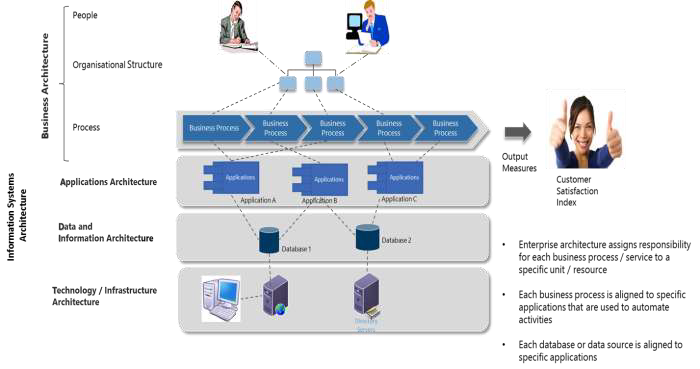
<a name="_bookmark7"></a>Enterprise architecture seeks to bring seamless alignment of the abovementioned domains to deliver value to the customer.<span style="letter-spacing: 2.0pt;"> </span>Thus in documenting end to end architecture for each entity, an association will be<span style="letter-spacing: -.3pt;"> </span>made<span style="letter-spacing: -.2pt;"> </span>between<span style="letter-spacing: -.25pt;"> </span>business<span style="letter-spacing: -.3pt;"> </span>services<span style="letter-spacing: -.3pt;"> </span>and<span style="letter-spacing: -.2pt;"> </span>business<span style="letter-spacing: -.2pt;"> </span>process<span style="letter-spacing: -.3pt;"> </span>which<span style="letter-spacing: -.3pt;"> </span>in<span style="letter-spacing: -.4pt;"> </span>turn<span style="letter-spacing: -.2pt;"> </span>will<span style="letter-spacing: -.35pt;"> </span>be<span style="letter-spacing: -.3pt;"> </span>mapped<span style="letter-spacing: -.25pt;"> </span>to<span style="letter-spacing: -.25pt;"> </span>the<span style="letter-spacing: -.2pt;"> </span>application that automate the processes (as well as the role or actors that are responsible for its execution).

Similarly,<span style="letter-spacing: -.4pt;"> </span>every<span style="letter-spacing: -.25pt;"> </span>application<span style="letter-spacing: -.25pt;"> </span>has<span style="letter-spacing: -.15pt;"> </span>to<span style="letter-spacing: -.2pt;"> </span>map<span style="letter-spacing: -.35pt;"> </span>back<span style="letter-spacing: -.25pt;"> </span>to<span style="letter-spacing: -.15pt;"> </span>the<span style="letter-spacing: -.15pt;"> </span>data<span style="letter-spacing: -.15pt;"> </span>sources<span style="letter-spacing: -.2pt;"> </span>where<span style="letter-spacing: -.15pt;"> </span>it<span style="letter-spacing: -.15pt;"> </span>stores<span style="letter-spacing: -.05pt;"> </span>and<span style="letter-spacing: -.2pt;"> </span>retrieves<span style="letter-spacing: -.1pt;"> </span>data<span style="letter-spacing: -.1pt;"> from.</span>

The infrastructure that support the systems has also to be mapped to the resultant technologies.<span style="letter-spacing: 2.0pt;"> </span>This seamless alignment is depicted in [*<span style="color: windowtext; text-decoration: none; text-underline: none;">Figure 4</span>*](#_bookmark6).

[![image.png](https://guidelines.risa.gov.rw/uploads/images/gallery/2025-10/scaled-1680-/5Z0image.png)](https://guidelines.risa.gov.rw/uploads/images/gallery/2025-10/5Z0image.png)