Architectural and Structural Design
The purpose of this section is to provide information to assist a designer in the planning and specification of a computer room and related spaces.
This section will focus on the architectural and general construction elements of a data center. Some reference will be made to other elements as the purpose of the architectural elements of a data center is to provide a physical envelope that assists in meeting the needs of the end user.
The plan of the datacenter should involve the client facility in charge, IT People will have more insights about their resource and requirements.
IT, telecommunications, and other users collect data and turn it over to the facilities manager who then puts together a team that locates a site, designs, and constructs the data center.
- Site Selection
- 24/7 Operation of Data Center - Temperature and Relative Humidity Control
- Materials
- General Paths of Access
- Planning Detail
- Computer Room
- Entrance Rooms
- Mechanical Room
- Electrical Room and UPS Room
- Fire Suppression Room
- Circulation
- Equipment Staging and Storage
- Floor Slab
- Computer Room Wall Construction
- Fire-Rated Construction
- Access Control Systems
- Airborne Particles
- Access Flooring System
- Ceilings
- Equipment Bracing System
- Structural Building Code Compliance and Coordination
- Structural Concerns Specific to Data Center Design
Site Selection
The site should not have interfering elements.
The below interfering elements should be eliminated
- vibration
- air contamination
- security
- Flood
- electromagnetic interference
- Hazardous materials
The site should have enough space around the building to allow for complete security and it must have enough space for support equipment such as Generators, fuel tanks, HVAC Heat rejection systems and the site should have all electric service requirements.
The site should have the nearest prevailing ground floor for equipment access, upper floors can contribute to structural instability and mostly the upper floors are not designed for the floor loading required for a datacenter.
If the data center is on a floor above the first floor, ensure that access is provided for the equipment required in the data center.
The data center shall be located as close as possible to incoming power to reduce the power cabling lengths.
The building should be designed to meet design criteria for seismic and wind lateral conditions.
The computer room shall be located on a floor that has the structural capabilities to support the equipment. The computer rooms should be in proximity to the telecommunications entrance room(s) of the building.
The computer room is best located on the ground floor. It is generally desirable to locate the computer room away from exterior walls although it may be appropriate to design a data center where the computer rooms have an exterior wall with knock-out panels for future expansion or integration of certain free cooling options. Where knock-out panels are used, precautions against storm/blizzard damage and temperature extremes (e.g., condensation) should be taken.
Critical data centers shall be installed within a steel or concrete framed building such as a Type I, II, or III building as defined in the regulation of Rwanda Standards board. Under certain conditions, Type IV construction can be utilized if constructed in accordance with Rwanda standards board.
The exterior of buildings shall be nonflammable and of durable material, resistant to the foreseen weather conditions for the expected lifetime of the facility.
The building section shall allow a minimum clear access height of 3 mm (10 feet) from slab-to-slab. The slab to structure above should be a minimum of 4.5 m (15 feet).
If datacenter is in multi-tenant building, it has to maintain the distance from hazards and mutual access points with other tenants.
All water lines, sprinkler lines, ductwork, and gas lines serving areas outside of the computer room shall not pass through the computer room area. No systems hazardous to the computer room shall be in or around the computer room.
All supply lines, ductwork, and telecommunication pathways serving the computer room shall not pass through the rooms of other tenants if comprehensive monitoring, protection against intrusion, and accessibility for maintenance cannot be guaranteed.
Services to the data center should be separate from services to other tenants.
24/7 Operation of Data Center - Temperature and Relative Humidity Control
All Tier 3 and Tier 4 datacenter should have security personnel within the datacenter and security at arrival and departure locations.
At high security facilities, walls, windows and doors of rooms typically permanently staffed (i.e., command center, a guard station) should be hardened or bullet resistant.
Twenty-four-hour operations shall have break facilities within the building in the vicinity of the data center.
The design of the computer room shall include proper insulation and moisture control to maintain a steady temperature and relative humidity ranges within the data center and the computer room shall be monitored so that temperature and relative humidity can be maintained with minimum energy usage.
Materials
The computer room shall be designed and built with new materials, which are durable, of superior quality, and easy to maintain and operate. Where recycled materials will not affect the operation of the space, they may be considered for use.
General Paths of Access
All entries into the data center shall be secured. There should be a direct communication between control center and the building guard station and it should be both audio and visual for high sensitive sites.
The points of access include main data center personnel access, non-data center personnel access, vendor equipment - access, access to support equipment, such as UPS and batteries, HVAC equipment, miscellaneous electrical equipment repair access, telecommunications vendor access, and separate user group access.
The maximum slope for ramps is 8° from horizontal for movement of cabinets with equipment. However, some accessibility regulations specify a maximum rise of 1:12, or about 4.8°. Additionally, the ramp shall be at least 900 mm (36 in) clear width, have handrails on both sides, and have a 1.5 m (5 feet) clear landing at the top and bottom.
If the computer room has only one ramp, it shall meet Rwanda Information Society Authority accessibility requirements. One ramp for equipment and an elevator or ramp for wheelchair access is acceptable.
The main access to the data center should be secured via some form of access control. This control can be a combination of personnel and electronics or solely electronics. Each client should consider the level of security necessary for protection of the data being processed.
Sites without a building guard should have both audio and visual controls at the initial point of access to the data Center.
In data centers occupied 24/7; it is recommended that the initial main access route lead into a secure location outside the computer room that provides additional control prior to entrance into the computer room. Observe life safety code regarding egress.
The data center shall allow for the delivery of computer and telecommunications equipment to the facility. The computer/telecommunications equipment delivery pathway, including doors, shall allow for delivery of equipment as large as 3 m (10 feet) long by 1.2 m (4 feet) deep by 2.4 m (8 feet) high, weighing greater than 3400 kg (7500 lb).
The routes for mechanical and electrical equipment shall be large enough to permit installation of new equipment and removal of old equipment—a clear height of at least 2.7 m (9 ft) is typically required along routes from the loading docks to the electrical and mechanical rooms. Clear height requirements shall consider the height of equipment, packaging, and moving equipment.
The local access providers require access to the telecommunications entrance rooms, but they are generally restricted from access to the computer room unless:
- The entrance room is a portion of the computer room.
- The computer room houses equipment such as DWDMs, SONET multiplexers, or other circuit provisioning equipment.
- The carrier demarcation points (e.g., DS-1 or DS-3 DSX panels) reside in the computer room.
Access control shall allow access by essential vendors that support the processing equipment. The access control system may require that such vendors be escorted. This control shall allow the data center personnel to know when and where the vendors access the data center.
Support equipment that requires servicing should be serviced on the perimeter of the data center to prevent untrained personnel from inadvertently damaging the processing equipment.
Planning Detail
The entry to the computer room from non-computer room spaces shall lead into a controlled space within the data center, prior to providing access to the computer room areas.
Entry for equipment, if separate from main entry, shall be controlled by the data center personnel only. The entry to the computer room should be positioned away from the direct access to the exterior.
Equipment entry should be located near a staging/storage area for unpacking and preparation of
equipment prior to entry into a computer room.
The Command center should be near the main entrance and shall house environmental monitoring equipment, computer system monitors, and space for the number of data center operators present at any given time. A console is recommended to house all monitors.
The command center shall be located so that it has direct access to the computer room space.
As needed, office and conference facilities shall be provided adjacent to the command center for supervisory functions and to form a war room or emergency troubleshooting area.
The printer room shall be provided adjacent to the personnel areas. The printer room shall be self- contained with a filtration system on the return air leaving the room. Space shall be provided for paper staying within the printer room to ensure the stabilization of paper.
For facilities that produce in-house removable record storage media and store in-house for an extended time the media that has been removed from the library, a separate room shall be provided for media storage. A separate media room in not required when media is removed from the library and directly transferred to a permanent off-site storage location.
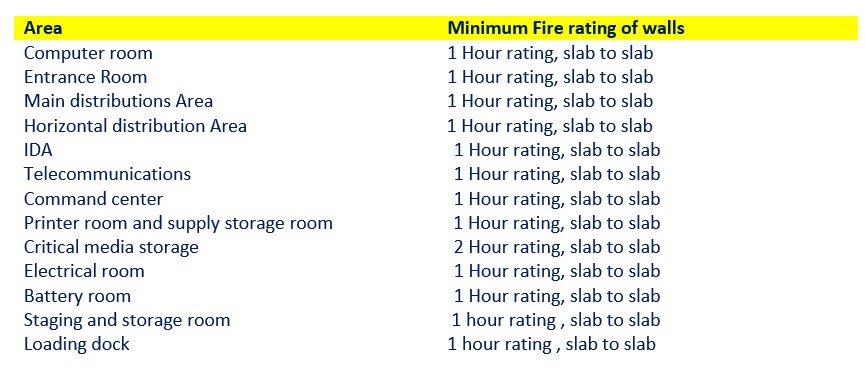
Storage of critical media shall be contained within a 2-hour fire rate enclosure.
Restroom and break room areas shall be provided with easy access to the operations and office areas. Restrooms shall be accessible, for both genders per the governing local codes and standards.
For 24/7 operations data centers, where practical, access to the restroom and break room should be within the security-controlled area of the data center.
Computer Room
The support equipment such as HVAC floor mounted air handlers, coolant distribution units, electrical PDU, static switches, fire suppression tank may require around 40% of overall space in the equipment area.
The cabinet and rack layout should be considered to allow for maximum flexibility. A data center may significantly change its ITE inventory every 3 to 5 years.
The data center planner should coordinate early on with mechanical and electrical systems designers. The computer rooms should be designed in a manner to provide adequate space for current equipment, growth, technology refresh, personnel and equipment circulation, and support equipment.
Production, development, and test systems should be in separate areas of the computer room, preferably in separate rooms served by dedicated networks.
Expansion should be planned into computer rooms. With the multitude of elements that affect the IT
environment, it is difficult to plan for exact expansion needs.
The mechanical should be segregated from ITE in the computer room for class F3 and F4 facilities since installation; servicing and maintenance will typically be performed by different personnel.
The physical barrier is recommended to accomplish the segregation between the mechanical and ITE, permeable to the airflow or by installing the HVAC components in a separate room adjacent to the computer room with opening for the airflow.
Entrance Rooms
Class 3 and higher data centers shall have separate entrance rooms and the entrance room if separate from the computer room, shall be accessed without going through the computer room.
Class 2 and lower data centers may have a single entrance room. The entrance rooms should be attached with the computer room.
Entrance room should consider the cable termination hardware, protectors, splicing hardware, cabling pathways, space for cable pulling equipment, carrier equipment, electrical equipment, air conditioning equipment, security equipment, building automation systems and telecommunications equipment.
Mechanical Room
Outside of the computer room provide space for the heat ejection equipment and associated pumps, fuel tanks and controls.
Mechanical components within a computer room should be located separate from the ITE rows in order to provide maintenance access.
Cooling systems should be located separate from the ITE rows in order to provide for maintenance unless placement in or close to the ITE row is necessary for enhanced cooling effectiveness.
Electrical Room and UPS Room
A separate room shall be provided to contain the data center associated electrical equipment, including the switchboard, various electrical panels, generator automatic transfer switch, UPS systems, and input/output boards.
Electrical and UPS room should be as near as possible to both the main building electrical room and the generator.
The electrical room may require two exits, with doors opening in the outward direction from the room, and the doors and equipment with panic hardware as required by Rwanda Information Society authority. Secondary exit routes may pass through other associated spaces such as the battery room if permitted by Rwanda Information Society authority. .
Battery rooms with batteries containing liquid, free flowing electrolyte shall include electrolyte spill containment and exhaust systems as required by local codes.
If the batteries are in a dedicated battery room, the battery room should be adjacent to the associated electrical room.
The battery room should be located at grade level if feasible. Below grade can create a flooding hazard. Above grade can create a floor loading hazard.
The battery room should be designed to accommodate the anticipated maximum floor loading. The battery room should not be located above a computer room space.
Fire Suppression Room
A separate room shall be provided for the pre action sprinkler control valve system for class 4 datacenter and a separate room is recommended for critical or Class 3 data centers.
Space shall be provided for the placement of clean agent fire suppression tanks as required. Tanks shall be located to assist easy serviceability. Tanks shall not be in the ceiling area above equipment.
Circulation
Clear pathways allowing for the movement of racks, processing, and support equipment shall be provided throughout the space in a direct path.
Circulation pathways shall be a minimum of 1.2 m (4 ft) wide with a minimum clear overhead of 2.4 m (8 ft).
Rows should not exceed 20 cabinets or racks in length. Dead-end aisles should be avoided whenever possible for the safety of personnel. Where dead-end aisles are not avoidable, they should be no longer than 10 cabinets or racks in length
Equipment Staging and Storage
Datacenter should have separate rooms to store arriving equipment and prepared in a room away from the computer room to prevent contaminants in the computer room and this room shall have filtration on the return air leaving the room.
The storage room can be part of a staging room or a separate room near the staging area for both arriving equipment and backup equipment such as boards, servers and other equipment.
A staging area should have the space for unpacking the preparing the arriving equipment and it should have space for large number of boxes and packing materials and consider fire protection requirements, frequency of removal and recycling to comply with local requirements.
A separate room for repair should be provided with easy access to both the equipment access and pathway to the computer room. An equipment repair room should have a work surface with multiple power and communications connections.
Caged areas should be provided for spare parts as necessary.
The building slab shall comply with all local building code requirements for protection against flooding, such as height above flood plain and setbacks from a flood plain.
All exterior openings and penetrations shall be sealed prior to work on interior walls or finishes in the computer room.
Floor Slab
Floor slabs shall be as per the calculations of the structural engineer, but no less than a floor loading of
7.2 kPa (150 lbf/ft2).
For elevated slabs, the concrete topping over metal deck flutes shall have a thickness of at least 100 mm
(4 in) to allow for the adequate embedment of epoxy and anchor bolts.
The floor slab shall be leveled and sealed with a non-penetrating seal, such as epoxy, which is a moisture barrier and prevents dusting and particulate.
In order to accommodate initial or future high-density equipment (e.g., disk arrays, fully loaded server cabinets), a minimum floor loading of 12.0 kPa (250 lbf/ft2) is recommended.
Computer Room Wall Construction
The perimeter walls to the computer room shall be slab-to-slab and the perimeter walls of the computer room shall provide the appropriate level of airtightness suitable for a clean agent fire suppression system.
All wall penetrations shall be fire sealed and sealed to prevent chemical fire suppression leaks.
The thickness and shapes of wall structural elements shall meet local authority requirements for the specific wall height to be built.
Metal studs used in constructing interior walls shall have a minimum thickness of 0.64 mm (0.025 in / 22
Gauge) for wall up to a height of 3.5 m (11.5 ft) and a minimum thickness of 1.0 mm (0.039 in / 18 Gauge)
for walls exceeding a height of 3.5 m (11.5 ft).
Studs shall have a minimum depth of 140 mm (5.5 in) to accommodate boxes and piping to be installed in the wall. Coordinate the thickness as all electrical and mechanical items shall be recessed or flush mounted.
Partitions touch a deck or vertical structural members; a joint isolator shall be provided to prevent transfer of vibration and structural loads.
Walls and other structural elements shall be designed for minimum deflection and securely fastened with isolation from all mechanical units and isolation pads or blocking at the top of the partitions.
For envelope walls separating the computer room from a non-conditioned or exterior space, insulation is to be provided as necessary to stabilize temperature migration. A minimum of R-3.3 m²·K/W (R-19 ft²·°F·hr/BTU) insulation is recommended.
Class 3 and Class 4 data centers may want to consider concrete masonry unit (CMU), concrete filled CMU, or tilt up concrete panels for the interior walls of the ITE, electrical, and mechanical space to provide additional structural integrity and high fire ratings.
In the interior of the computer room, partitions that are not required for rated separation shall be from top of access floor to the ceiling above unless additional height is required for security or environmental control. Nonrated walls shall be braced at a minimum of every 3 m (10 ft) and as required to meet lateral bracing requirements of the IBC.
Moisture/vapor seal should be provided completely around humidity-controlled spaces to prevent vapor
Infiltration to and from the computer room.
Doors shall be large enough to move equipment between various data center rooms. Doors must be high enough to allow equipment entry on pallets without tilting.
Doors shall have a minimum thickness of 45 mm (1.75 in) and be a minimum of 1.1 m (3.67 ft) wide by 2.4 m (8 ft) high for a single door or 1.8 m (6 ft) wide by 2.4 m (8 ft) high for a pair of doors. Doors shall be mounted within steel frames, have a solid core, and be either wood or steel.
These doors shall have neither a center post nor doorsills.
All doors and frames within a rated partition assembly (1-hour or 2-hour) shall be rated at the code required rating of that assembly for occupancy rated separations (as per fire protection of Rwanda standards board requires fully rated doors). Doors shall have an air tight and fire-rated weather stripping all around the opening.
All doors along the entire route (i.e., from the loading dock to the computer room) should be a pair of doors.
Glazing within doors shall not exceed 0.065 m2 (100 in2). These requirements are for equipment and main exit doors to the computer rooms.
Glazing within rated doors shall be fire rate and set in metal frames. Glazed openings within rated partitions shall not exceed code limitations as set by the construction standards advised by Rwanda standards board.
Glazed openings within partitions shall be metal frame construction with glazing set in continuous stops
(such as neoprene) to prevent vibration.
Fire-Rated Construction
Walls separating computer room, electrical rooms, battery rooms, mechanical rooms, and separate TRs from other areas within the building shall be a minimum of 1-hour separation or as required by applicable codes and regulations.
Doors and frames within a rated wall shall match the rating of the wall construction.
Glazing within a rated wall shall match the rating of the wall. Electrical rooms and battery rooms, as defined by IBC (International Building Code)Table shall have glazing within the doors only.
Floors above and below each of the spaces listed in below Table shall be a 2-hour rated, as defined in IBC (International Building Code). See below Table for the fire rating of spaces.
Access Control Systems
Access control shall be provided at all entrances to the data center and all entrances to the computer room.
A system that allows for multiple levels of controls shall be installed to provide for different levels of security in different portions of the data center.
The access control system shall allow for easy modification of access control, be completely programmable, and provide a digital and hard copy of all access to the data center and its various components.
Airborne Particles
Non-conductive airborne particles can be minimized by:
- Doing all unpacking, cutting, and drilling outside the computer room
- Keeping cardboard boxes and manuals outside the computer room
- Prohibiting food or drink inside the computer room
- Avoiding carpets in computer rooms
- Using ceiling panels that have an impervious surface such as drywall panels with a vinyl covering
- Use of air filtration with regular replacement of filters
- Keeping printers, copiers, and tape media in separate rooms with separate HVAC systems
- Occasional professional cleaning of the access floor, subfloor, and overhead ducts
- Preventive maintenance cleaning of equipment, cabinets, and racks
- Place brushes, grommets, or other material in access floor openings to minimize loss of air
pressure and airborne particulates. - Fire marshals usually require that all combustible materials be stored outside the computer rooms and, in cases where aluminum floor tiles are used, keep printer toners out of the computer room to avoid thermite reactions.
- It is recommended that the designer verify that the manufacturer has tested for the resistance of zinc whisker development or has acted through the manufacturing process to mitigate whisker development. Some examples of mitigation include:
- Electroplated zinc coated or hot dip galvanized zinc coated with a special addition of other material preventing whisker growth.
- Powder coated with enough thickness
- Use of non-ferrous or stainless-steel materials
Access Flooring System
Underfloor concrete shall be cleaned and sealed after all major underfloor work has been done, including installation of the access floor system itself.
The access floor shall be a minimum of 450 mm (18 in) above the slab. When determining the minimum raised floor height for an air plenum, the mechanical designer shall analyze the height required achieving the desired air distribution.
Considerations shall include all under-floor airflow obstructions such as network cabling pathways, power systems and pathways, and cooling system piping.
Raised floor heights of 900 mm (36 in) are common.
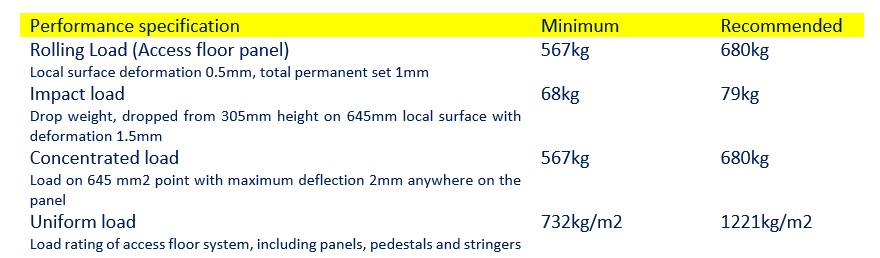
The building's structural system supporting the access floor must support the access floor and all imposed loads.
The assembly shall be leveled and locked at a selected height, requiring deliberate action to change the height setting and preventing vibration displacement.
Pedestals shall be secured to the slab using a method acceptable to the access floor manufacturer and Rwanda Standard Board. This is typically performed using bolts, adhesives, or seismically isolated floor systems.
Stringers shall be used for all access floors exceeding the height of 500 mm (20 in).
All tiles shall be supported at all four sides/corners, and the tile surface shall have anti-static properties in accordance with IEC 61000-4-2(International Electro technical Commission's immunity standard on Electrostatic Discharge (ESD).
A structural engineer shall be consulted to provide a recommended maximum number of contiguous tiles and stringers that can be removed at any one time, and this information shall be incorporated into the operational guidelines for the data center.
For higher power density equipment where the underfloor space is used for cooling, the access floor should be a minimum of 900 mm (36 in) above the slab.
If the location has seismic activity, the access floor selected should be designed by the manufacturer for seismic applications, installed in accordance with the manufacturer’s instructions, and certified by a professional structural engineer.
Additional structural and operational criteria/factors to consider should include:
- Panel drop tests
- Maintaining panel integrity for a given cut-out size
- Pedestal axial loads
- Pedestal overturning moment
- Stringer mid span concentrated loads
- Permanent sets and deformations of any system components
- Pedestal bases should be glued directly to the concrete slab and not to the epoxied/painted slab
Ceilings
In data center computer rooms and telecommunications spaces (e.g., entrance rooms, TRs), the minimum ceiling height should not be less than 3 m (10 ft) from the finished floor to any obstruction such as sprinklers, lighting fixtures, or cameras
Minimum 450 mm (18 in) clearance from sprinklers to raceways, cabinets, and racks shall be maintained to ensure that they do not disrupt the sprinkler distribution pattern subject to the Rwanda Information Society Authority.
The recommended ceiling height for computer room spaces (from slab-to-slab) is 4.5 m (15 ft or greater). A suspended ceiling may not be required for computer rooms that do not use the ceiling space as an air-
return. Benefits of an open ceiling (where not required for cooling) are the visibility of any technical problem and the ease of access to installations and pathways mounted underneath the ceiling slab.
Office-type ceilings should not be installed in new data center spaces. Depending on the design for the cabinets and the HVAC solution, there may be an HVAC solution design requirement to provide a ceiling return air plenum.
The materials used and the design of this type of ceiling shall consider any need to support cable trays or other cable pathways for overhead cabling in the data center.
Ceiling requirements should be developed taking into consideration non-flaking or dusting tiles, vapor resistance, and hold down clips for gaseous fire suppression discharge or high-volume airflow and acoustics. Materials known for metal whiskers (e.g., zinc, tin, cadmium), whether electroplated, pre- galvanized, or hot dip galvanized, should be excluded from ceilings.
Equipment Bracing System
Equipment cabinets and racks shall be braced in accordance with local codes. Cabinets braced at the top can utilize the cable ladder rack system, if present, with an attachment that provides rigid four-directional lateral bracing. Equipment mounted on access floors in seismic areas shall be braced to the underfloor slab with an approved method. The bases of cabinets and racks should be braced to the slab as appropriate for the seismic demand in accordance with local seismic codes or requirements.
Structural Building Code Compliance and Coordination
Local building codes shall be consulted in the planning and implementation of changes to the building and its mechanical, electrical, and life safety systems.
All loads on the structure are divided into various types:
- Dead loads, soil loads, hydrostatic pressure loads
- Live loads
- Flood
- Snow
- Rain
- Ice
- Seismic
- Wind
The magnitude of forces on any structure is a function of its geographic location. Rwanda Housing Authority identify the forces expected to be applied to buildings and nonstructural components. The applied forces are a function of probability at a given location for environmental loads (e.g., wind, ice, snow, flood, tsunami, and earthquake).
Critical facilities requiring higher performance should consider loads and performance requirements contained in the UFC 3-310-04(Seismic Design of Buildings) and UFC 3-301-01(structural engineering), or regional equivalent.
Additional loads that may warrant consideration for data centers include tsunami and ice impact loads because of shedding on adjacent structures such as telecommunication towers.
Structural Concerns Specific to Data Center Design
Floor loading (superimposed live load) shall be a minimum of 7.2 kPa2 (150 lbf/ft2) with 1.2 kPa (25 lbf/ft2) hanging dead load (weight that can be supported from the underside of the floor or roof). This floor load is adequate for most data center areas.
1.2 kPa (25 lbf/ft2) hanging dead load, the recommendation in this standard is a uniform load of 12.0 kPa (250 lbf/ft2) with 2.4 kPa (50 lbf/ft2) hanging dead load to provide flexibility in the location of higher floor loads such as large storage arrays, printing facilities, and densely populated blade server cabinets.
In specific regions of the access floor area where this equipment is located, the structural engineer should be notified of the specific operating weights.
Floors for battery rooms should be designed for a minimum superimposed live load of 12.0 to 23.9 kPa
(250 to 500 lbf/ft2).
Roof areas over battery rooms should be designed to support a minimum suspended dead load of 1.4 kPa
(30 lbf/ft2).
Raised Access Floors
Raised access floors are commonly used in data centers. When raised access floors are in use, all raised access floors shall meet Rwanda standards board special access floor requirements.
Raised access floors shall be designed and tested as a Designated Seismic System and shall have Special Certification Requirements as defined in the Rwanda standards board. The response spectra shall be calculated at the bottom and at the top of the raised access floor to determine the demand on the equipment mounted on the floor. The response spectra shall be computed for the in-structure response accounting for the structural support in addition to the response characteristics of the raised access floor.
The Rwanda standards board do not appropriately address seismic vertical ground motions and the amplifications of vertical ground motions in the structure. The nuclear industry and military industry require the calculation of the seismic demand because of vertical ground motions that is referred to as the seismic demand. UFC 3-310-04(Seismic Design of Buildings) can be used as a reference to determine a methodology to seismically qualify raised access floors.
Because of the importance of data centers, an in-structure response analysis should be used to compute the coupled response of a raised access floor. A coupled response can then be used to develop response spectra for equipment mounted on the raised access floor.
Equipment that is determined to be mission critical shall be designed and tested to determine the seismic demand and the equipment fragility. The seismic demand of mission critical equipment shall be determined at the point of attachment of the equipment.
Equipment determined to be mission critical shall specify the performance expectations. The seismic demand shall be determined at the point of attachment. The point of attachment may be a structural element, or it may be a nonstructural component (such as a raised access floor). If required, a coupled dynamic analysis may be required to determine seismic demand.
Wind
In the design of data centers, the implementation team should verify the wind-loading calculations with Rwanda Environment Management Authority for wind and it has to be considered in the project plan.
Earthquake
Data centers are placed in International building code Risk Category IV because of their criticality. The owner may elect to use a reduced Risk Category rating of II if the facility does not have to operate after an earthquake.
Designating a facility as Risk Category IV will still not necessarily ensure a data center will be functional following a major earthquake. If a facility is intended to be operational with a high degree of confidence following a major seismic event, it should be designed in accordance with the provisions of UFC 3-310-
04(seismic design of building) for Risk Category V.
For data centers, special attention must be paid to the design of specific nonstructural components, such as raised access floors, that will have a direct impact on the survivability of the computer functions after an earthquake.
Depending on the height of the raised access floor and the amount of a mass supported as well as the magnitude of the earthquake, it may be necessary to isolate the access floor from the rest of the structure.
The process of isolation is generally referred to as base isolation. Base isolation is also a valid consideration for the entire building. Base isolation creates other concerns for elements that cross the plane of isolation. Care must be taken in the anchorage of generators, chillers, fans, switchgear, piping and conduit, and racks. The force on the support for these elements will be substantially increased as a function of their mass multiplied by the dynamic coefficients addressed in the code enforced earthquake design. The in- structure demand response spectra must be compared to the fragility of the nonstructural component.
Blast and Terrorist Attack
Many data centers are designed to resist the effects of a terrorist attack. Terrorist attacks can be in many forms, but the most prominent attack is in the form of a blast from some manner of vehicle-borne improvised explosive device (VBIED). Security experts and law enforcement should be consulted to quantify the size of an explosive device.
Security and physical site barriers should be constructed to maximize the distance that a VBIED can be from the data center. The blast dynamic pressures can be calculated and compared to the response of the data center structure and building envelope elements. Guidance for blast-resistant design may be found in the regulations of Rwanda standards board.
Smaller explosive devices can be mitigated by screening processes that place the threat at a defined distance from the facility.
Terrorist attacks can take many forms that can include introducing chemical, biological, or radiological agents into a facility. Protection should include screening for compounds that could be brought into a facility clandestinely and controlling air supply into a facility.