# Sector Digital Maturity Assessment and Action Plan
Within the responsibility of infusing and enhancing the sector's digital culture, the CDO also must enhance the digital maturity of the sector.
Sector digital maturity refers to the **level of advancement and sophistication in the adoption, integration, and utilisation of digital technologies within a particular ministry or sector**.
Maturity models are widely used tools, typically **employed for self-assessment**, to help organisations gauge their current capabilities in specific functional, strategic, or organisational areas. By self-assessing and discussing various maturity levels and descriptors, organisations can develop a shared understanding of the changes needed to advance to higher maturity levels over time.
It encompasses various dimensions, including **Governance** in the digital landscape, the extent to which digital **processes and tools** are embedded in the sector's operations and strategies, the **employees digital literacy** and IT readiness and the **change management** in digital field relevance.
Assessing digital maturity involves evaluating how effectively a sector leverages digital innovations to enhance efficiency, service delivery and citizen engagement.
A tool is designed to help CDOs to conduct the digital maturity assessment in the Rwandan context. Structured into **4 pillars**, each **pillar is structured into axis and sub-axis**. Each sub-axis is made of **several questions with 5 options**. The CDO must **choose the option that is the most suited to the current sector’s current situation**. Based on the option selected, the tool will give a score for each axis and pillar.
**The Pillars of the Digital Maturity Model:**
1. **Governance:** Assesses strategic alignment, leadership commitment, digital policies and reporting routines regarding digital
2. **Tools, Processes, and Methodologies**: Reviews the sophistication, automation, standards, and integration of digital tools and technologies in the Business.
3. **People and Resources:** Evaluates workforce skills, training programs, teams’ composition and size, and the collaborative culture supporting digital transformation.
4. **Change Management**: Analyses communication strategies, change adaptability and internal collaboration to improve innovation.
**The levels of the maturity grid are: **
1. **Initial stage: **describes sectors that have not yet defined their digital path and are still relying on legacy and traditional processing methods.
2. **Emerging stage: **describes those sectors that have undertaken or are undertaking digitization reforms as part of their progress towards the medium level of digital maturity.
3. **Operational stage: **describes sectors that have reached a certain level of maturity thanks to structured actions undertaken in the past. The sector is beginning to be rewarded in terms of digital integration, the alignment of digital with business objectives.
4. **Advanced stage: **describes sectors that have developed in terms of digital maturity. They serve as a benchmark for other sectors, use digital to drive innovation, are well shared across the organisation and are continually improving to stay at the forefront of digital trends.
5. **Leading: **This level is intended to represent the leading edge of what is generally possible today, with some collaboration with stakeholders. Sectors here are looking at what might be possible in the longer term, moving towards more transparent and increasingly demanding industry standards.
[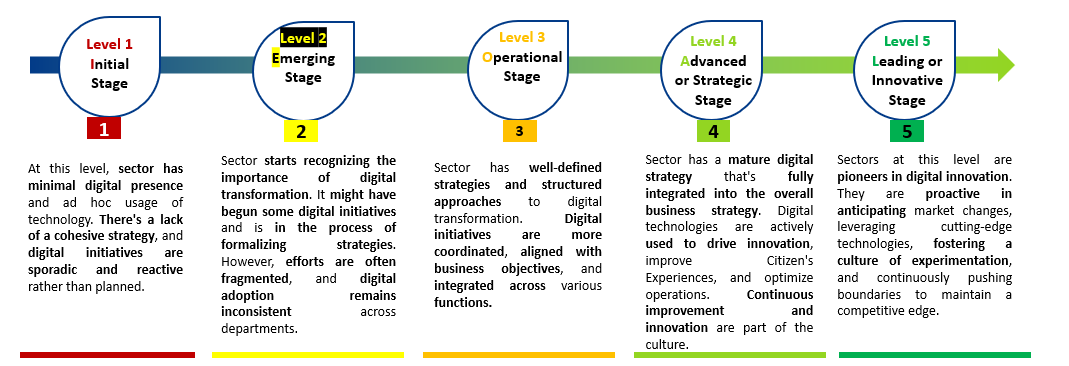](https://guidelines.risa.gov.rw/uploads/images/gallery/2025-05/digital-maturity-model-levels.png)
*Figure 10: Digital Maturity Model levels*
On each axis, several questions are designed to be completed by RISAs because the axes and sub-axes analysed are managed at RISA or central level. These areas should be monitored by RISAs, although CDOs may still make recommendations.
When filling in the Maturity Model, CDOs should gather some prerequisites:
**Plan the assessment in advance:** planning the assessment means finding the relevant resources to participate in the assessment. A referent can be designated per axis regarding the nature of each talent work in a team. For example, the one in charge of Cybersecurity in the team is well placed to conduct the assessment on the Cybersecurity axis.
**Find enough time to conduct the assessment**: The assessment can be done pillar per pillar and not necessarily the whole grid at one time. The depth demanded by each question requires time to be devoted to the exercise, and CDOs need to ensure that this is the case.
**Use the KPIs set developed in the framework of the grid prior to the assessment** in order to reduce subjectivity. Please refer to RISA to get the KPIs set associated with the Digital Maturity Model.
**Be honest in your self-assessment**: don't forget to fill in the column on justification so that you can check the option you have chosen.
**Include a party from outside the Ministry in the evaluation**: For example, a CDO from another ministry/sector could take part in the evaluation, act as referee/moderator to settle any differences of opinion and provide an outside perspective.
**Continue to monitor progress from one year or assessment period to the next.**
**Provide feedback to RISA when applying the tool in order to enhance.**
The **step after the completion of the Digital Maturity Model** is to **draw an action plan** to **reach the next level of maturity**. To draw the action plan, CDOs can rely on the description of each step in the digital maturity through the options. For example, selecting option 2, means that to reach the next level, the sector should complete the following statement or option.
The action plan should then be sent to RISA for validation before implementation.
[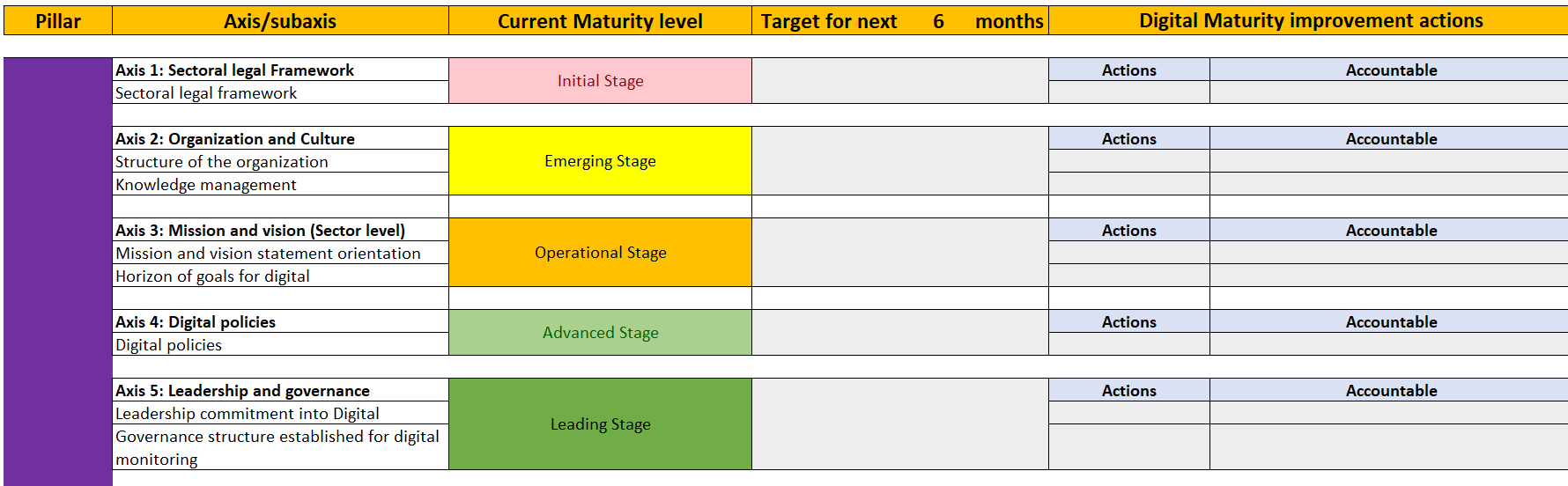](https://guidelines.risa.gov.rw/uploads/images/gallery/2025-05/extract-of-the-action-plan-to-enhance-sectors-digital-maturity.png)
*Figure 11: Extract of the action plan to enhance sector’s digital maturity*
After having identified the actions and having defined them in the Action Plan table, CDOs should share the Action Plan with the Accountable persons identified for agreement and follow-up. Regular follow-up meetings must be scheduled to monitor the implementation of the action plan.