# Context of The CDO Position
As digital becomes increasingly central to Rwanda's development Strategy, the Rwandan government has recognised the major importance of digital transformation in stimulating economic growth and improving the delivery of public services. To this regard, the CDO structure was set-up by the Government from 2020 to drive the digital transformation projects in all sectors and Ministries of the Rwandan Government.
As of today (in 2024), 14 sectors (Justice, Education, Health, Agriculture, Infrastructure, Environment and Disaster Management, Foreign Affairs, Sports, Finance, Local Government, Gender and Family Promotion, Trade and Industry, Public Service and Labor, Ministry of Interior) have shared IT units that are each led by a Chief Digital Officer or a Business Analyst. Increasingly other sectors have also started to adopt the positions of CDO/CIO (RSSB, King Faisal Hospital, National Bank).
The CDO Structure’s vision within the Government of Rwanda aims to utilise digital transformation initiatives for enhancing service delivery, boosting efficiency, and fostering economic growth across all sectors.
The creation of this network signifies a crucial stride in harnessing the potential of digital technology to revolutionise the Country's economy and enhance the well-being of its citizens.
[](https://guidelines.risa.gov.rw/books/chief-digital-officers-handbook/page/context-of-the-cdo-position/edit?content-id=bkmrk-the-cdo-depends-on-t&content-text=The%20CDO%20depends%20on%20the%20RISA%20to%20which%20it%20reports%20di "Jump to section in editor")The CDO depends on the RISA to which it reports directly.
# Presentation: the Concept of “shared services”
The words “Shared service by sector” is defined by the Ministry of Public service and Labor as follows:
“Job positions which were integrated in the organisation structures of the line Ministries to serve institutions in the same sector excluding those that were relocated to secondary cities and other few exceptions due to the nature of some institutions. Those shared services by sector include Planning and M&E, Human Resource Management, Legal Affairs, Internal Audit and IT function”.
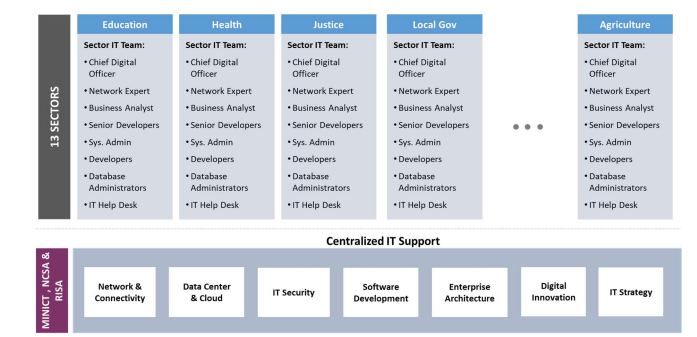
The initiative accompanied a redesigned IT governance structure. The core idea involves aligning institutions with similar mandates into sectors, where a "sector" denotes a leading Ministry with its affiliated agencies operating in the same line of business. This Strategy revolves around shared IT services and personnel to cater to the collective needs and plans of the entire Sector. Ministries with shared IT units are overseen by either a Chief Digital Officer or an IT Business Analyst.
[](https://guidelines.risa.gov.rw/uploads/images/gallery/2025-05/the-framework-of-shared-services.png)
*Figure: The framework of Shared Services*
The consolidation approach is implemented by clustering Government institutions within the same business sector. In this setup, IT resources are shared within the Sectors and at the National Level (RISA, NCSA & MINICT). The IT workforce is mobile and dynamically allocated to different locations based on prevailing needs and priorities.
Example of a Sector IT (Environment and Disaster Management Sector) Institutions under the “Environment and Disaster Management” Sector include the Ministry of Environment, Rwanda Land Management Authority, Rwanda Mining Board, Meteorological Agency and other affiliated institutions.[](https://guidelines.risa.gov.rw/uploads/images/gallery/2025-05/5O5the-framework-of-shared-services.png)
*Figure: Example of a sector IT: case of the Environment and Disaster Management Sector*
# Objectives of the Shared Services Mechanism
The reorganisation for IT departments around Shared services will enable a successful digital transformation and meet the various demands and expectations from citizens, stakeholders, partners and employees. More specifically, the objectives are as follows:
- **Accelerating the digitization efforts for Rwanda** in response to national targets in National Strategy documents and promoting innovation;
- **Promoting IT standardisation, reducing spending on systems procured from abroad**, removing duplications and achieving efficient service delivery across the entire Government;
- **Consolidating and** **modernising technology platforms to ensure better quality of service** to citizens;
- **Reducing the cost of IT resources by achieving economies of scale through consolidation of IT purchases** at Ministry level;
- **Achieve greater consistency and satisfaction for the end-users** through the introduction of better citizen-oriented design principles;
- **Stronger data governance to drive best-practice in intelligent reporting** and business insights paving the way for more elaborated use cases of Analytics and Artificial intelligence;
- **Focus on preventive management rather than reactive management** to achieve greater stability of IT systems (i.e.; preventive maintenance).
# Positions and Reporting Mechanisms under the shared services
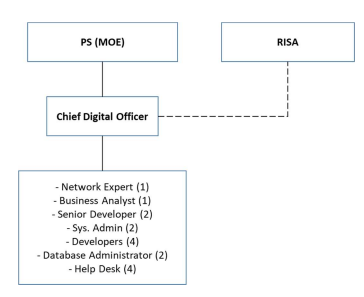
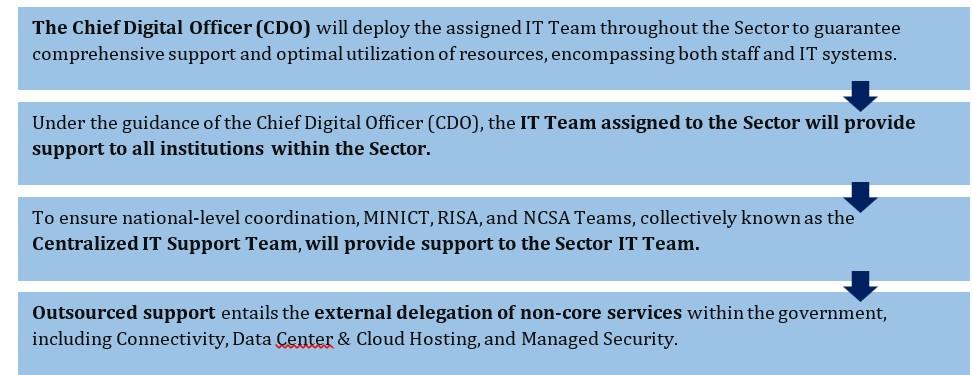
The clustering approach revolves around establishing a unified IT Team, headed by a Chief Digital Officer (CDO) or an IT Business Analyst. This team is responsible for offering IT leadership, support, and the development of IT systems for all institutions within the Sector. The remaining members of the IT Team are distributed under the lead Ministry and within each of the sector's institutions. Additionally, the CDO maintains a direct reporting line to RISA, serving as the supervising authority.
[](https://guidelines.risa.gov.rw/uploads/images/gallery/2025-05/example-of-an-organisation-structure-of-sector-it-case-of-the-ministry-of-environment.png)
*Figure 8: Example of an organisation structure of sector IT: case of the Ministry of Environment*
*[](https://guidelines.risa.gov.rw/uploads/images/gallery/2025-05/fig9.jpg)*
*Figure 9: Shared services, key principles*
Shared services within a leading Ministry and its affiliated agencies involve the centralised provision of certain functions and resources to achieve efficiency, cost savings, and improved collaboration. Here are some common shared services in the ICT context for a Ministry and its affiliated agencies. Implementing shared services in these areas promotes consistency, cost-effectiveness, and improved overall performance across the Ministry and its affiliated agencies in the realm of Information and Communication Technology.
**Area 1: IT Infrastructure Management:**
- Centralised management of IT infrastructure, including servers, networks, and data centres.
- Maintenance and updates of hardware and software across all affiliated agencies.
**Area 2: Network Services:**
Shared network services such as internet connectivity, VPNs (Virtual Private Networks), and intranet services.
**Area 3: Cybersecurity Services:**
- Centralised cybersecurity measures, including firewalls, intrusion detection systems, and antivirus solutions.
- Monitoring and response to cybersecurity threats across all affiliated agencies.
**Area 4: Data Management and Analytics:**
- Centralised data storage and management services.
- Analytics services for extracting insights from data shared across different agencies.
**Area 5: Software Development and Support:**
- Shared services for software development, customization, and support.
- Collaboration on common applications and platforms to avoid duplication of efforts.
**Area 6: Help Desk and User Support:**
- Centralised help desk services for providing technical support to users across affiliated agencies.
- Standardised procedures for issue resolution and user assistance.
**Area 7: ICT Procurement:**
- Centralised procurement of ICT hardware and software to leverage bulk purchasing and negotiate better deals.
- Standardisation of ICT procurement processes.
**Area 8: Training and Development:**
- Shared training programs for building ICT skills among employees.
- Centralised resources for continuous professional development in the ICT domain.
**Area 9: Cloud Services:**
- Utilisation of cloud services for shared storage, computing power, and applications.
- Collaboration on cloud-based solutions to enhance efficiency and reduce costs.
**Area 10: Collaborative Platforms:**
- Implementation of collaborative platforms for communication and project management.
- Shared tools for document sharing, collaboration, and workflow automation.
**Area 11: ICT Governance and Policy:**
- Development and enforcement of standardised ICT governance and policy frameworks.
- Oversight and compliance monitoring across all affiliated agencies.